The post FoodSHIFT email forum appeared first on FoodSHIFT 2030.
]]>Stay connected and join the FoodSHIFT+ email forum – the Rise Up email forum for multi-actor food partnerships across Europe and beyond.
Email [email protected] to be signed up by the platform.
Once subscribed, email [email protected] to ask questions or share information and it will be received by the entire list.
Frequently Asked Questions (FAQs)
Who can join this email forum?
Everyone involved in the FoodSHIFT2030 project, including the core project team, the FoodSHIFT Accelerator Labs (FALs), Fellow cities (FELs) and network partners. Multiple people from the same lab, partnership or organisation can sign up to the forum.
As the project comes to a close at the end of 2023, FoodSHIFT + has extended the invitation to all multi-actor food partnerships who have come across the project, attended workshops and webinars, and would like to stay connected with work happening across Europe.
Why join?
FoodSHIFT+ connects all those working across the FoodSHIFT network. It provides a platform for communication and knowledge sharing, a place to share challenges, questions, news and updates relevant to sustainable food systems and multi-actor partnerships.
How does it work?
Knowledge sharing made simple! Once you’re signed up, you receive emails straight to your inbox with no need to log in to check messages.
– To sign up people need to email [email protected]
– Once subscribed you can ask your questions or share info by emailing [email protected] and it will be received by the entire list.
– To unsubscribe from this list, email [email protected].
What can I post about?
You are welcome to share anything related to your project which you believe would be of interest to the rest of the network, including relevant research, insights, and events, as well as particular challenges or questions you might have related to food system partnerships.
Topics might include:
- Questions on specific areas cities, councils, partnerships are struggling with e.g. how/whether to encourage citizen involvement in food partnerships; how to measure emissions saved from improved public procurement, how to work most effectively with businesses in a food partnership, etc.
- Examples of local success, developments you are proud of and would like to share, or need advice on
- Webinars and event news
- New reports and developments from other sector organisations
- International grants available on this theme
- Job posts
- Wider themes such as food governance, food citizen engagement and more
The size limit for messages is 500Kb, which means that users will not be able to share attachments in posts.
How often can I post?
You can post as often as you like, and remember to invite everyone within your local food partnership to sign up!
Will the forum be moderated?
Yes. The moderator will keep an eye out for posts that violate the forum’s user guidelines. Any such post will be removed by the moderator.
Can I use the forum to communicate with my assigned FoodSHIFT project partner?
No. This forum is not for sharing detailed project work and sensitive documents that relate to specific bilateral or multilateral work streams between FAls and FELs. This is not an internal communication channel to carry out FoodSHIFT related project work.
Can I use this forum as an archive and list/search materials for FoodSHIFT legacy work?
No. This forum does not work as a library of materials. It is not a mini site or a shared drive. When someone posts in the forum, you will receive an email but there is no website or page for you to access to search back for previous posts unless you have saved the emails personally.
User Guidelines
No Spam / Advertising / Self-promotion
This forum defines spam as unsolicited advertisement for goods, services and/or other web sites, or posts with little, or completely unrelated content.
Do not post copyright-infringing material
Providing or asking for information on how to illegally obtain copyrighted materials is forbidden, this also includes internal and confidential FoodSHIFT 2030 documents such as the Grant Agreement or Consortium Agreement
Do not post “offensive” posts, links or images
Any material which constitutes defamation, harassment, or abuse is strictly prohibited. Material that is sexually or otherwise obscene, racist, or otherwise overly discriminatory is not permitted on this forum.
Remain respectful of other members at all times
All posts should be professional and courteous. You have every right to disagree with your fellow community members and explain your perspective. However, you are not free to attack, degrade, insult, or otherwise belittle them or the quality of this community.
The post FoodSHIFT email forum appeared first on FoodSHIFT 2030.
]]>The post FoodSHIFT2030 Consortium Reunion! appeared first on FoodSHIFT 2030.
]]>The pandemic period influenced each project, also FoodSHIFT2030. After two years, finally, the representatives of the whole consortium met in Wroc?aw (Poland) during WRO LAB Showcase and Roundtable. The meeting took place from 20th till 22nd June. The main focus of the meeting was to present the WRO FAL progress, plans, and challenges, as well as catch up with ongoing and planned tasks within Work Packages.
The first day of the Showcase, June 20th, was focused on the presentation of WRO FAL – what is behind them and what lies ahead. Some successful stories were presented, such as establishing more edible gardens at schools as the citizen interest was significant. Therefore, the Wroc?aw Municipality found additional funds to meet the needs and interest in FoodSHIFT2030 schools’ edible gardens. Moreover, the Municipality of Wroc?aw joined the Milan Urban Food Policy Pact!

Among other stories worth mentioning was the Community Supported Agriculture (CSA) which was established at the Wroc?aw University of Environmental and Life Sciences (WUELS). This is a unique example of CSA where 100 employees of the university are taking food boxes (veggies & fruits) produced by the university. And, as researchers from WUELS said, there could not have been a better place to start the creation of a CSA than a natural science university. More FoodSHIFT2030 direct and indirect impacts on the food system in Wroc?aw were presented, i.e. two student projects carried out by the Student Scientific Organization of spatial planning PUZZLE from WUELS. PUZZLE decided to compete for funds for the realization of two community gardens – for seniors (2020) and the school community (2021). These projects have received funding under the Student Activities Fund from the Wroclaw Academic Center (FAST, WCA).
One of the most interesting events of the first day was a panel discussion with food innovators. Food innovators each shared stories about their activities, successes, and challenges. Each of them also discussed what assumptions are behind the activities of their initiative.

The second day of Showcase, June 21st, was focused on shared learning experiences and knowledge transfer from the WRO FAL. Therefore, two local visits have taken place: one to the school edible garden established within Foodshift2030, and the other one to the community garden – O?bin’s Open Garden (org. O?bi?ski Ogród Otwarty – OOO), the first well-established and functioning community garden in Wroc?aw, as well as the WRO FAL food innovator. The visit to OOO allowed obtaining feedback on what FoodSHIFT2030 activities could target this type of food innovator (ie. training on how to keep community members engaged and manage people, tasks within this type of initiative). As at the last RT, we learned local ways of making food. One of the WRO FAL food innovators, Tajfun Restaurant, prepared a workshop for us on pickling (fermentation) – a traditional Polish way of preparing food for the autumn-winter season. During the first and second day of the meeting, we were accompanied by local products (vegetables, fruits, preserves, goat cheeses, and vegan cheese alternatives – made from sunflower seeds) provided by WRO FAL food innovators.


Source of Photo: Fundacja EkoRozwoju, photo by Arkadiusz Wierzba.
After WRO LAB Showcase, it was time for activities related to WPs, i.e. first results from a network analysis of food system actors were presented, or the potential of Metropolitan Foodscape Planner (MFP) together with MapTable has been presented.
The background of the meeting was ensured by: Odra Centrum – a sustainable meeting place on water dealing with the protection of water and environment by education and other dedicated actions; vegetarian/vegan, local, seasonal food; public transport or electric scooters using; selection of accommodation taking care about the environment. The undertaken background was important to be consistent with the project’s main goals: shifting to a more plant-based diet and low carbon emissions.
Check out all the photos from Wroclaw Consortium at this link!
The post FoodSHIFT2030 Consortium Reunion! appeared first on FoodSHIFT 2030.
]]>The post EU FOOD 2030 Project Family, by the numbers! appeared first on FoodSHIFT 2030.
]]>
EU FOOD 2030 Project Family, by the numbers!
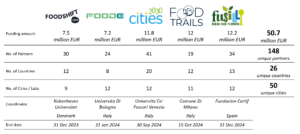
Following up on the previous introduction to the EU FOOD 2030 Project Family and the five founding EU funded projects, FoodSHIFT 2030, FoodE, Food Trails, Fusilli and Cities 2030 comes a ‘by the numbers’ summary of the scale of this international mutli-actor network. Starting with over 50 million EUR being collectively awarded to the five projects from the EU Horizon programme.
The highly diverse, multi-national EU FOOD 2030 Project Family includes over 140 funded partners operating in 26 countries. The five consortia are each different in their structure, but all have the same fundamental need for wide range of partners resulting in the representation of all types of food system actors including; start-ups, SMEs, NGOs, municipalities, governmental bodies, advocacy agents, researchers, collectives, producers, retailers, citizens policy-makers and impact investors.
Of even more significance is the inclusion of 50 unique city-regions in 21 countries that have each received have funding for local innovators, initiatives, and in some cases, living labs. These city regions within the EU FOOD 2030 Project Family are listed below by country:
- The highest representation is 8 Italian city-regions (Bari, Bergamo, Bologna, Milan, Naples, Rome, Turin and Vicenza)
- Next are 6 Spanish city-regions (Barcelona, Castelo Branco, Quart De Poblet, Sabadell, San Sebastian and Tenerife)
- The Netherlands and France each have 4 city-regions (Amsterdam, Groningen, Haarlem and Lansingerland) and (Avignon, Bordeaux, Grenoble and Romainville)
- 2 city-regions for Belgium (Bruges, Ostend), Croatia (Rijeka, Velika Gorica), Finland (Seinäjoki, Tampere) and Germany (Berlin, Bremerhaven)
- 2 city-regions also for Greece (Athens, Thessaloniki), Norway (Longyearbyen, Oslo), Poland (Warsaw, Wroclaw), Romania (Brasov, Ia?i) and Slovenia (Ljubliana, Murska Sobota)
- Finally 1 city-region for Tirana in Albania, Troodos in Cyprus, Vidzeme in Latvia, Differdange in Luxembourg, Funchal in Portugal, Nilufer in Turkey and Birmingham In The United Kingdom.
You can view all of the FOOD 2030 Project Family City-Regions on this map, and, there is plenty more where that came from as these figures are yet to include individual innovators, network organisations nor fellow/cascade cities of which there are many!
Published by Luke Schafer
FoodSHIFT 2030 Scientific Project Manager
https://foodtrails.milanurbanfoodpolicypact.org/
The post EU FOOD 2030 Project Family, by the numbers! appeared first on FoodSHIFT 2030.
]]>The post EU FOOD 2030 Project Family appeared first on FoodSHIFT 2030.
]]>
EU FOOD 2030 Project Family, an introduction
The EU FOOD 2030 Project Family is a collaboration of five EU Horizon projects coordinating synergistic cross-project initiatives towards a sustainable transformation of the European food system aligned with European Commission’s FOOD 2030 and Farm to Fork Strategy.
This collaboration is a self-coordinated approach with project representatives attending quarterly planning meetings with an alternating project host and FoodSHIFT 2030 project hosted the latest EU FOOD 2030 Project Family quarterly planning meeting. Some of the joint cross-project initiatives include under development:
Producing joint webinars where key expertise and best practices from city-regions shared across the five projects and brought to public audiences
Expanding our collective reach by developing cross-project strategies for communication and dissemination and considerations for a joint Horizon Results Booster application.
Maximizing the impact of accumulative project legacy items with considerations for a joint EU FOOD 2030 Project Family Manifesto
Translating FOOD 2030 communications and key project messages into policy directives for the EU in the form of a providing a joint advocacy statement to the European Commission’s Sustainable EU food system initiatives open consultation for legislative framework for sustainable food systems.
This cross-project approach will be active for the foreseeable future and thereafter, it is the ambition that the Project Family is continuously carried forward by newly funded projects. Thus, providing a fundamental link enabling the pooling of synergistic expertise, outputs and tools that increase EU funding efficiency and have greater collective influence on the transformation of the European Food System.
Published by Luke Schafer
FoodSHIFT 2030 Scientific Project Manager
https://foodtrails.milanurbanfoodpolicypact.org/
https://food.ec.europa.eu/horizontal-topics/farm-fork-strategy_en
The post EU FOOD 2030 Project Family appeared first on FoodSHIFT 2030.
]]>