The post PREVIEW: THE FOODSHIFT TRANSITION TOOLKIT appeared first on FoodSHIFT 2030.
]]>July 2023
The FoodSHIFT consortium is happy to announce the official delivery of the FoodSHIFT Transition Toolkit! The Toolkit is currently available for consortium use and will be made publicly accessible in September 2023. This will be announced via the FoodSHIFT2030 social media channels and website, so keep an eye out for further updates!
What is the Transition Toolkit?
The Transition Toolkit is your one-stop shop for all things Food System Transition. Based on the rich experiences in the FoodSHIFT2030 project, the Toolkit provides users with inspiration, resources, guidelines and tools for understanding and contributing to food system transition.

The FoodSHIFT Transition Toolkit: Expected in September 2023 for public access
The toolkit covers the following food system transition topics:
- Innovation Cases – real-life innovation examples and inspiration from the nine FoodSHIFT Living Labs.
- Knowledge Base – comprehensive materials and resources providing theoretical and practical guidance for food system transition, including:
- Frameworks & Guidelines
- Tools & Methods
- Policy Practices
- Webinars & Briefs
- Living Lab Support Pathways – Interactive resources to support food system transition across four key transition impact areas, including example contributions from FoodSHIFT Living Labs:
- Citizen Empowerment
- Job Creation
- Sustainability
- Governance

The FoodSHIFT Transition Toolkit: Living Lab support to transition
Who is the Transition Toolkit for?
The Toolkit is for all stakeholders in the food system transition, including city officials, urban planners, food businesses & entrepreneurs, researchers, consultants, practitioners, local authorities and citizens. The toolkit provides these user groups with the resources to stimulate and contribute to the food system transition in their own cities, based on the experiences and lessons from the FoodSHIFT 2030 which will come to a close at the end of this year.
How do I find out more about the Transition Toolkit?
For more information about the Toolkit, follow the FoodSHIFT2030 project on LinkedIn, Twitter and Instagram to keep updated about the public launch of the Toolkit in September, as well as by subscribing to the FoodSHIFT2030 newsletter.
Or check the foodshift2030.eu website for updates and access in September.
Do you have a specific question about the Toolkit? Contact the Toolkit developer team at [email protected]
The post PREVIEW: THE FOODSHIFT TRANSITION TOOLKIT appeared first on FoodSHIFT 2030.
]]>The post FoodSHIFT email forum appeared first on FoodSHIFT 2030.
]]>Stay connected and join the FoodSHIFT+ email forum – the Rise Up email forum for multi-actor food partnerships across Europe and beyond.
Email [email protected] to be signed up by the platform.
Once subscribed, email [email protected] to ask questions or share information and it will be received by the entire list.
Frequently Asked Questions (FAQs)
Who can join this email forum?
Everyone involved in the FoodSHIFT2030 project, including the core project team, the FoodSHIFT Accelerator Labs (FALs), Fellow cities (FELs) and network partners. Multiple people from the same lab, partnership or organisation can sign up to the forum.
As the project comes to a close at the end of 2023, FoodSHIFT + has extended the invitation to all multi-actor food partnerships who have come across the project, attended workshops and webinars, and would like to stay connected with work happening across Europe.
Why join?
FoodSHIFT+ connects all those working across the FoodSHIFT network. It provides a platform for communication and knowledge sharing, a place to share challenges, questions, news and updates relevant to sustainable food systems and multi-actor partnerships.
How does it work?
Knowledge sharing made simple! Once you’re signed up, you receive emails straight to your inbox with no need to log in to check messages.
– To sign up people need to email [email protected]
– Once subscribed you can ask your questions or share info by emailing [email protected] and it will be received by the entire list.
– To unsubscribe from this list, email [email protected].
What can I post about?
You are welcome to share anything related to your project which you believe would be of interest to the rest of the network, including relevant research, insights, and events, as well as particular challenges or questions you might have related to food system partnerships.
Topics might include:
- Questions on specific areas cities, councils, partnerships are struggling with e.g. how/whether to encourage citizen involvement in food partnerships; how to measure emissions saved from improved public procurement, how to work most effectively with businesses in a food partnership, etc.
- Examples of local success, developments you are proud of and would like to share, or need advice on
- Webinars and event news
- New reports and developments from other sector organisations
- International grants available on this theme
- Job posts
- Wider themes such as food governance, food citizen engagement and more
The size limit for messages is 500Kb, which means that users will not be able to share attachments in posts.
How often can I post?
You can post as often as you like, and remember to invite everyone within your local food partnership to sign up!
Will the forum be moderated?
Yes. The moderator will keep an eye out for posts that violate the forum’s user guidelines. Any such post will be removed by the moderator.
Can I use the forum to communicate with my assigned FoodSHIFT project partner?
No. This forum is not for sharing detailed project work and sensitive documents that relate to specific bilateral or multilateral work streams between FAls and FELs. This is not an internal communication channel to carry out FoodSHIFT related project work.
Can I use this forum as an archive and list/search materials for FoodSHIFT legacy work?
No. This forum does not work as a library of materials. It is not a mini site or a shared drive. When someone posts in the forum, you will receive an email but there is no website or page for you to access to search back for previous posts unless you have saved the emails personally.
User Guidelines
No Spam / Advertising / Self-promotion
This forum defines spam as unsolicited advertisement for goods, services and/or other web sites, or posts with little, or completely unrelated content.
Do not post copyright-infringing material
Providing or asking for information on how to illegally obtain copyrighted materials is forbidden, this also includes internal and confidential FoodSHIFT 2030 documents such as the Grant Agreement or Consortium Agreement
Do not post “offensive” posts, links or images
Any material which constitutes defamation, harassment, or abuse is strictly prohibited. Material that is sexually or otherwise obscene, racist, or otherwise overly discriminatory is not permitted on this forum.
Remain respectful of other members at all times
All posts should be professional and courteous. You have every right to disagree with your fellow community members and explain your perspective. However, you are not free to attack, degrade, insult, or otherwise belittle them or the quality of this community.
The post FoodSHIFT email forum appeared first on FoodSHIFT 2030.
]]>The post Let us help you measure the sustainability of your food system appeared first on FoodSHIFT 2030.
]]>Let us help you measure the sustainability of your food system
The FoodSHIFT 2030 Sustainability Scoring System (FSSS) is a new online tool which aims to help the different stakeholders apply sustainable food innovations to their food system.
Sustainability has become an increasingly important issue for the food system, as it not only concerns the environment, but it has also social and economic aspects. Many food system stakeholders are looking for ways to apply sustainable food innovations to their food system. This is where the FoodSHIFT 2030 Sustainability Scoring System (FSSS) comes in.
FSSS is prepared to be a simple, user friendly, online tool which aims to enable food system stakeholders around the world to assess the impacts of different food system innovations. This article discusses what FSSS aims at, how it will work, who can use it, who developed it, and how it was established. The full deliverable D6.3 is available for download here or accessible as well in the resource section.
FSSS, is developed for communication and demonstration reasons, and will be available soon through the FoodSHIFT website and the FoodSHIFT transition toolkit. In particular, FSSS:
- will demonstrate to the different stakeholders the multiple benefits they can have, when applying sustainable food-related innovations in their food system.
- provides ideas to its users on innovations they can apply, and combine, in their food system by comparing sustainable benefits and having access to real cases.
- can help different stakeholders to develop their sustainability strategies and approaches, in line with their priorities and their different needs.
How does FSSS work?
?he user can select from a list of innovations, related to their interest, and see how these innovations can influence the sustainability dimensions (environmental, social, governance, and economic) of a food system. The innovations have already been rated by a dedicated team based on SDGs indicators before being uploaded to the platform for use.
Who performs the scoring?
Prior to their uploading on the platform for use, the innovations have been already rated, regarding their contribution to the sustainability of a food system, based on SDGs indicators, by a dedicated team of experts who have been carefully selected by the FoodSHIFT 2030 team.
Who can use FSSS?
The Food Sustainability Scoring System (FSSS) is an innovative tool designed to promote sustainability throughout the entire food value chain. Its aim is to provide practical and actionable solutions to a wide range of stakeholders, including citizens, schools, local authorities, food processors, service industry, and agricultural producers.
FSSS targets the following stakeholders:
- For educational and research institutions, FSSS provides examples of sustainable food innovations that can be implemented in their establishments. This can be used for both practical purposes, such as reducing food waste in school kitchens, and educational reasons, such as developing school gardens.
- Local authorities can also benefit from FSSS by identifying sustainable food strategies and increasing food-related sustainable actions in their cities. This can help them plan and implement more carefully their sustainable food policies.
- Food processors, such as food processing industries, can use FSSS to generate profits while benefiting the environment. By applying sustainable food innovations in their businesses, they can communicate these benefits to customers and personnel.
- The service industry, which includes restaurants, hotels, canteens, and the hospitality sector, can also use FSSS to implement sustainable food practices. This can not only benefit their businesses but also the planet.
- Agricultural producers can use FSSS to positively impact the sustainability of the food system. By adopting innovative technologies and new business practices, they can interact with other value chain players and increase the overall sustainability of the food system.
Lastly, citizens are key target groups as they are both consumers and influencers of the food system. Educating citizens is an important factor for success in creating sustainable food value chains, and FSSS can demonstrate how their actions can positively influence the system.
In conclusion, FSSS is a powerful tool that can be used by a wide range of stakeholders to promote sustainable food practices. Its potential to positively impact the entire food value chain makes it an essential resource for creating a more sustainable future.
Overall, the FSSS is a valuable tool for promoting sustainable practices in the food sector, and its comprehensive approach ensures that all stakeholders are included in the process of improving food sustainability.
Who prepared FSSS?
The methodology for the FSSS was prepared by DRAXIS Environmental S.A., a leader in Work Package 6 (WP6) of the FoodSHIFT project, with support from UCPH and SUSMETRO. Once the FoodSHIFT project is completed, the FSSS will be accessible through the FoodSHIFT transition toolkit (lead by SUSMETRO), and the list of FSSS innovations is aimed to continue to be enriched and after the end of the FoodSHIFT 2030 project.
Selecting FoodSHIFT2030 SSS innovations
The research team, after conducting appropriate research, agreed that the most appropriate system to assess the selected food system innovations, and to measure their impacts based on the SDGs principles, is the recognized system of SAFA (Sustainability Assessment of Food and Agriculture Systems – FAO)
Categories of FSSS innovations
The innovations were separated in the following categories:
- Product – Innovations in this category address new or updated products, including quality, safety and market impact.
- Process – These innovations are relevant to new technologies for processing, logistical improvements, infrastructure and new/improved services.
- Social – Innovations in this category are relevant to changes in behavior (e.g., consumers/citizens), development of new relationships and inclusiveness.
- Governance – The innovations address policy developments, including food planning, subsidies, taxing, certificates & labelling.
Scoring
The scoring of the innovations performed in FSSS does not relate to rating the different innovations regarding which is better or worse. It rather aims, through this process, to present the character of an innovation, examining the benefits that it brings to a food system. The assessment of the sustainability of innovations will be qualitative, based on the opinion from experienced experts from different related disciplines in the food system.
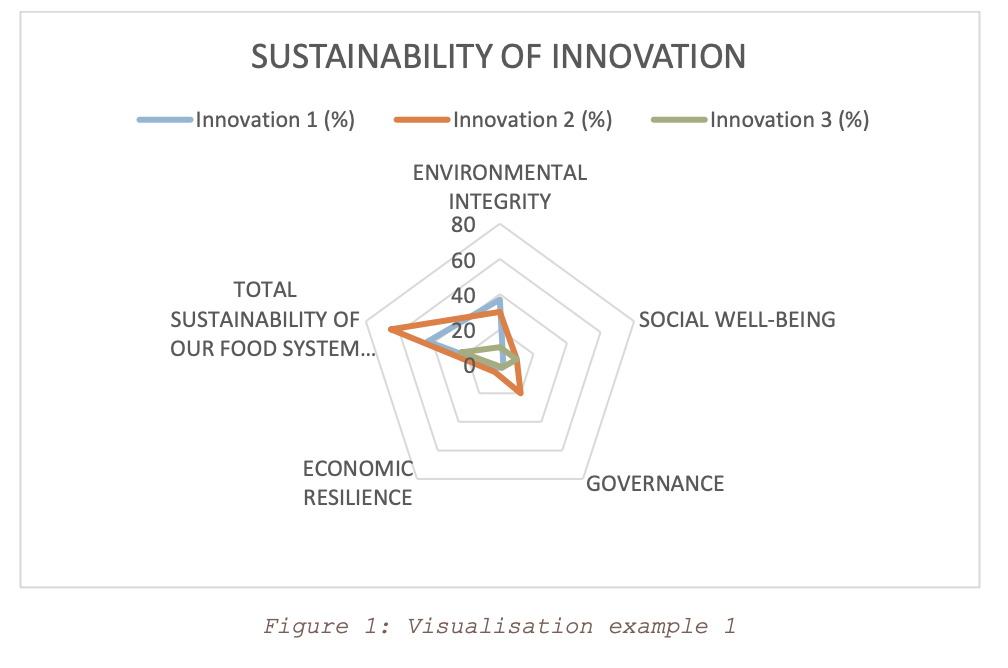
Example of sustainability scoring visualisation
Do you want to be the first to know when FSSS goes live? Then sign up to our newsletter or reach out to Aida at [email protected]
The post Let us help you measure the sustainability of your food system appeared first on FoodSHIFT 2030.
]]>The post Innovators: Meet the people changing your food system appeared first on FoodSHIFT 2030.
]]>In these portraits, each of the 90 innovators has been profiled using compact descriptive section addressing the key activities and achievements so far as well as the near future perspectives under the heading ‘Looking ahead’. The one-page portraits are complemented by infographics on the impacts and the relevant contact details.
For quick orientation, the innovations have been categorized according to four innovation dimensions: product, process, social & governance. These dimensions enable us to identify what kind of innovations are being initiated across city regions and provide suitable, relevant support.
These rich examples give us a glimpse of how food system innovations can look, and how they can be effective in addressing elements of the food system, and the relevant stakeholders that are involved. Together, these innovators and related stakeholders form the Innovation Ecosystem in their city-region, which has the potential to redefine local food systems.
Supporting Innovations
In addition to these differing innovation dimensions, the Innovation Portraits also highlight the varying maturity levels seen among innovations. This maturity refers to the developmental stage of an innovation, which can be useful in identifying the needs and next steps that an innovator can take to bring an idea to life, from Eureka! moment to viable product or service.
Based on the maturity of an innovation, we can establish what kind of support would be best suited to the innovator. This support takes three main forms:
Maturing – advancing an innovation for better application as a solution. E.g. improved functioning of the innovation, better organizational structure, developing a business strategy…
Combining – linking of different innovations for strategic purposes. E.g. partnerships to facilitate new services, resource sharing, collaboration towards a common goal (coalitions, associations…)
Upscaling – increasing the impact and/or outreach of an innovation. E.g. increasing production, adding new products or services, outreach to new markets or communities, open-source knowledge sharing…
The Innovation Portraits provide us with an important reflection of the food system transition, in that many innovations are still early on in their maturing process, and in addition to the passion and ambition of the innovator themselves, will require targeted support and enabling conditions to thrive.
Providing us with snapshots of diverse innovators per city region, the Innovation Portraits also offer us an opportunity to consider how the Innovation Ecosystems in these city regions look. For example:
- Which innovators have (potentially) complementary resources, products or services?
- Which partnerships can be formed?
- Which innovators have a common interest or goal?
In particular, these questions can open the door to opportunities for combining, stimulating activity in the local Innovation Ecosystem. Looking at long-term perspectives, upscaling is a key acceleration mechanism for innovations that are at a high level of maturity and wish to increase their reach and impact.
Discover all INNOVATORS at a glance here!
Opportunities for Change
The 90 cases highlighted by the Innovation Portraits provides not only an inspiring portfolio of the diverse innovations that are actively contributing to food system transition, but also an example of how individual action, by individual innovators, can kick-start the development of an innovation ecosystem. These innovation ecosystems are fundamental in challenging the status-quo of food systems, and can generate awareness, interest and engagement with change. Through supporting the innovators highlighted in these Innovation Portraits, the FoodSHIFT2030 consortium hopes to accelerate the transition to a low-carbon, circular and plant-based food system in Europe.
Download the Innovation Portrait brochure here.
The post Innovators: Meet the people changing your food system appeared first on FoodSHIFT 2030.
]]>The post Cost of living crisis – takeaways appeared first on FoodSHIFT 2030.
]]>Cost of living crisis: From farm to fork, food system innovators are fighting back
The cost of living crisis and rising energy prices are affecting every link in the food chain; with many food producers and retailers having to close shop, and citizens struggling with their household budgets. Access to healthy, sustainable produced food is seriously at risk as pressure mounts on the slow food movement to give way to intensive farming and cheap, highly processed foods. But rather than give way, radical food system innovators are rising up to the challenge and adapting to the times. This webinar will explore responses to the crisis in three different areas, looking at how businesses, government and citizens can respond.
In the UK, growers, producers and veg box schemes are working collectively with organisation Better Food Traders, to drive up efficiency, save costs and ensure a steady supply chain, all the while participating in innovative schemes to ensure the most vulnerable still have access to fresh fruit and veg.
At food partnership Food Plymouth, the council is working closely with local suppliers to ensure continued procurement contracts. As the need for food aid increases in the city, citizens are now being invited to set up bulk buying cooperatives in their neighborhoods to retain their agency amid the crisis.
In Berlin, Germany, a decentral network of food hubs is being developed by neighbours and community spaces, looking to build up collective cooking, food sharing and solidarity with small producers, stepping in where the traditional food structure has not.
Watch the recording of the webinar here:
Download the presentations below:
Better Food Traders presentation
The post Cost of living crisis – takeaways appeared first on FoodSHIFT 2030.
]]>The post A participatory tool for assessing land footprint in city-region food systems—A case study from Metropolitan Copenhagen appeared first on FoodSHIFT 2030.
]]>The ongoing COVID-19 pandemic has exposed the fragility of current food systems to feed populations around the world. Particularly in urban centers, consumers have been confronted with this vulnerability, highlighting reliance on just-in-time logistics, imports and distant primary production. Urban food demand, regional food supply, land use change, and transport strategies are considered key factors for reestablishing resilient landscapes as part of a sustainable food system. Improving the sustainability of food systems in such circumstances entails working on the interrelations between food supply and demand, rural and urban food commodity production sites, and groups of involved actors and consumers. Of special significance is the agricultural land in close proximity to urban centers. Calling for more holistic approaches in the sense of inclusiveness, food security, citizen involvement and ecological principles, this article describes the use of a new decision support tool, the Metropolitan Foodscape Planner (MFP). The MFP features up-to-date European datasets to assess the potential of current agricultural land use to provide food resources (with special attention to both plant- and animal-based products) and meet the demand of city dwellers, and help to empower citizens, innovators, companies, public authorities and other stakeholders of regional food systems to build a more regionalized food supply network. The tool was tested in the context of the food system of the Copenhagen City Region in two collaborative workshops, namely one workshop with stakeholders of the Copenhagen City Region representing food consultancies, local planning authorities and researchers, and one in-person workshop masterclass with MSc students from the University of Copenhagen. Workshop participants used the tool to learn about the impacts of the current food system at the regional and international level with regard to the demand-supply paradigm of city- regions. The ultimate goal was to develop a participatory mapping exercise and test three food system scenarios for a more regionalized and sustainable food system and, therefore, with increased resilience to crises. Results from this implementation also demonstrated the potential of the tool to identify food production sites at local level that are potentially able to feed the city region in a more sustainable, nutritious and way.
Read and download the complete paper here: https://foodshift2030.eu/resources/
The post A participatory tool for assessing land footprint in city-region food systems—A case study from Metropolitan Copenhagen appeared first on FoodSHIFT 2030.
]]>The post FAL BRA?OV EXPERIENCE – CONSORTIUM REUNION EDITION appeared first on FoodSHIFT 2030.
]]>Between the 6th and the 8th of September, FAL Bra?ov had the chance to host the FoodSHIFT2030 partners and invite them to take part in the FAL Bra?ov experience! Autumn came earlier in the mountain city, but with a bit of luck, weather was sunny and warm during the field trips where we learnt about the Bra?ov city-region food system and met the innovators.
Day 1 started with a short introduction about the city-region’s food production capacity and trends, to ensure a common understanding of the food situation and to provide the needs assessment of the food strategy, which is one of the most important goals of FAL Bra?ov.
The main challenges that Bra?ov city region faces in relation to its food system are:
- Integrating small producers in the food system by professionalisation and aggregation.
- Promoting local gastronomy and local menus.
- Encourage and strengthen rural-urban linkages and cohesion.
A part of these challenges is tackled by the first two innovators that were introduced.
- Mihaela Fr??il?, expert on public procurement worked on integrating local producers in the local public procurement for the `meal in school` program and assembled a list of recommendations for the national authorities that manages this program.
- ‘?inutul Bârsei’ Local Action Group will organise a course for the professionalisation of the small producer, for a better integration in the local food system.
The second half of the day was spent in the M?gura village, part of the Piatra Craiului National Park, where the participants visited a local household and learnt about the difficulties that small producers from mountain areas face, while tasting local cheese, donuts and ?uic?. Lunch was served as Villa Hermani, a certified ecotourism pension that represents a good practice example of business in a mountain area that integrates local producers.

The day ended with a visit to Bran Castle where the participants tasted a re-interpretation of traditional kneaded cheese (`brânz? de burduf`) prepared by Chef Dana Graur?, with whom FAL Bra?ov is collaborating for creating the local menus scheme.

Day 2 started with a trip to the city’s biggest vegetables and fruit market, Dacia Market, where we met and discussed with the director of the Administration of Public Markets of Brasov Municipality, Mr. Ladariu Adrian, and with the producers, after which we visited the Star Market, the place intended to become a food hub, where the SolBun Cooperative is meeting with consumers every Wednesday and Saturday.


SolBun Coop is one of the innovators, which aggregates vegetables and dairy local producers in a marketing cooperative.
The last innovation presented was Chef M?d?lina Roman work on reducing food waste in restaurants (which can be seen in this video).
The day continued with the session dedicated for project work: clarifying work packages inputs and timelines, as well as toolkits that will come.
All participants were invited to the Consortium Dinner, which took place at CATTIA and was prepared with local products by Chef Bogdan Cozma and his team.
The last day of the FAL Bra?ov experience started with an ambitious workshop on local food governance that reunited local stakeholders (public administration and authorities, local businesses, local researchers), as well as FoodSHIFT2030 partners.

FAL Bra?ov experience ended with a visit to `HOF H?rman` local gastronomical point. We visited the household, including the two gardens, and then had the delicious plant-based lunch prepared by Ioana and Corina.
- The local gastronomical point is a small family-run touristic farm, offering food prepared from ingredients that can be found in the family`s or neighbours` gardens and prepared after local recipes and techniques.
The overall objective was to share with the partners and participants the FAL Bra?ov’s experience, to immerse them in the local gastronomy and tastes, and into the daily lives of local producers working in mountain regions, making the participants aware of the challenges that these producers face daily. Last, but not least, to emphasise the need for local cooperation and prioritisation of a sustainable local food system.
Useful links to know more:
- Brasov local Press Release
- Latest FoodSHIFT2030 Press Release
- SolBun Coop innovator page on FoodSHIFT2030
- Chef M?d?lina innovator page on FoodSHIFT2030
- Chef M?d?lina video
The post FAL BRA?OV EXPERIENCE – CONSORTIUM REUNION EDITION appeared first on FoodSHIFT 2030.
]]>The post Assessing food self-sufficiency of selected European Functional Urban Areas vs metropolitan areas appeared first on FoodSHIFT 2030.
]]>The resilience of the local food system is being underlined as one of the most important strategic goals for a sustainable future. However, since the question of what constitutes the local scale of food production depends largely on the type of product and supply chain, the associated foodshed can range from a site scale, city and city region up to wider region and country level. As a proof of concept whether functional urban areas (FUAs) can serve as references for local food systems, we provide evidence on their capacity to provide vegetarian diet supply to their residents. Applying the Metropolitan Foodshed and Self-Sufficiency Scenario (MFSS) model methodology we estimate the level of potential food self-sufficiency of the FUAs. We quantitatively compare the results for FUAs with the results of local planning documents of metropolitan areas. The approach is applied to 9 city regions representing different European countries: Wroc?aw (PL), Ostend (BE), Berlin (DE), Avignon (FR), Copenhagen (DK), Bari (IT), Brasov (RO), Athens (EL), Barcelona (ES). The results show that vegetarian and local food demand could be satisfied in first five FUAs of these city regions. However, if the same number of calories as current diet delivers is to be maintained only the first three FUAs have enough agricultural land to supply vegetarian ingredients to this diet. The results for metropolitan comparison return the same three cities plus Bari. We discuss the use of FUA in defining foodshed area and the role of consumers’ dietary choices in regional food self-sufficiency.
Read and download the complete paper here: https://foodshift2030.eu/resources/
The post Assessing food self-sufficiency of selected European Functional Urban Areas vs metropolitan areas appeared first on FoodSHIFT 2030.
]]>The post Farm to Fork webinar appeared first on FoodSHIFT 2030.
]]>Soaring energy prices, the rising cost of living and threats to our food system brought on by the war in Ukraine have provoked panicked calls for more intensive farming and a scaling back of green ambitions, including the recent decision from the EU agricultural ministers to allow production on marginal land. But these calls detract us from our long-term, but most urgent need to achieve net zero and will reverse any gains in food security for a fairer, greener, healthier Europe. We need to stick to the Farm to Fork food strategy, which lies at the very heart of the European Green Deal, if we want resilient food systems now and in the future.
In this webinar, EU Horizon 2020 project FoodSHIFT2030 is joined by network partners Sustain: the alliance for better food and farming, IFOAM Organics Europe and Eat, to discuss transforming food systems in European city-regions in line with the Farm to Fork strategy. Protecting wildlife, forging greater links between urban and rural areas, building fairer supply chains for our farmers and food entrepreneurs, as well as promoting more plant-based food consumption in the
cities are just some of the areas of work.
In 2020 we argued it necessary in light of Covid-19, and today’s crisis is no different – we need Farm to Fork for a sustainable, resilient food system which ensures everyone has access to healthy, nutritious food.
Speakers include:
- Dirk Wascher, Innovation Manager FoodSHIFT 2030 (Chair)
- Silvia Schmidt, Policy Associate Manager, IFOAM Organics Europe
- Vicki Hird, Head of Sustainable Farming, Sustain
- Christian Bugge Henriksen, FoodSHIFT2030 Project Coordinator
- Olav Kjørven, Senior Director of Strategy, EAT
WATCH THE RECORDING:
Download the presentations here:
Christian Bugge Henriksen presentation
Download Q&A session
The post Farm to Fork webinar appeared first on FoodSHIFT 2030.
]]>The post Financing and fundraising appeared first on FoodSHIFT 2030.
]]>in the city food systems
Some FALs have asked to get more information about possible ways of getting funds for their innovators. This topic is very complex, as getting successful with fund raising and accessing financing requires many skills and knowledge.
This first webinar on the topic will be an introduction with short inputs from experts, and questions/answers short sessions. Participants will get basic knowledge about the specifications of setting up business models for social entrepreneurs, and a short introduction to 3 main sources of funds / finance: the crowdfunding, the impact investment, and the European funds.
To get deeper understanding and share their experiences in the funding/financing processes, the FALs will be invited to a next FAL2FAL webinar, on Friday 21 January, where there will be more time for deeper discussions, especially in the topics “business models for social entrepreneurs” and “crowdfunding”.
More FAL2FAL webinars on this topic will be organized in the future, based on expression of interest from the FALs.
Objectives
• Gaining knowledge about the social entrepreneurship funding / financing logics and timing
• Discovering the impacts investment logics and opportunities
• Learning good practices in crowdfunding
• Learning about how to get involved in more European projects
Learning outcome
• At the end of this webinar, participants should have increased knowledge and capacities to raise funds and finance for the innovators involved in the FoodSHIFT2030 project.

The post Financing and fundraising appeared first on FoodSHIFT 2030.
]]>