The post Copenhagen’s story: Kitchen of tomorrow Lab appeared first on FoodSHIFT 2030.
]]>Key takeways
- The Copenhagen focus was on reconnecting the city with its hinterlands by strengthening ties between food chain actors in public procurement
- They chose this focus of local procurement as a logical next step to build on the successful organic conversion of all the public kitchen in Copenhagen Municipality to a 90% share of organic produce in the last 15 years.
- The experience from the conversions in the kitchens led to an understanding that the kitchens need continuous motivation to stay on track. An organic percentage rising is motivational. This calls for a need for other easy and motivational data for the kitchens to follow to become more sustainable beyond organic
- For this reason, a tool to analyse procurement data on a range of indicators is developed. It can provide data on seasonality, country of origin and number and size of suppliers – and hereby provide transparency for the kitchens
- By now, this tool was launched and used successfully in a multitude of kitchens in Denmark and beyond
- This is especially impactful when seeing the challenges, the Copenhagen city faced during the project: some project partners left the project due to changing political agendas and business closures while the strong Danish farming lobby advocated for competing interests
- For a city wanting to embark on a similar journey, the recommendation is to establish a lab leader, build out key competences and ideally gain direct municipal support
Interview with the Copenhagen Lab Coordinators
What was your city’s specific focus in your food system transition and how did you initially start working with this focus area in your city?
Line Rise Nielsen
It is a bit of a special story about the Copenhagen lab which might require some backstory. When we started discussions of being part of FoodSHIFT, there was an organization in Copenhagen called “Copenhagen House of Food”. They had been responsible for an organic conversion of all the public kitchens in Copenhagen and Denmark overall over the last 15 years. Just before we got in contact with FoodSHIFT, we had started to look into what would be the next step since, at that point, we had nearly achieved our goal of being 90% organic, in the Copenhagen municipality at least. We were almost close to achieving that goal and then we decided that we would recommend for the politicians to aim for short supply chains and having the rest of Zealand, the “backyard” of Copenhagen, included.
That was the basis on which we started to have a dialogue in the Copenhagen lab between three or four municipalities and a region and we started to see that we needed some money to figure out what the way ahead could be. And then one of the municipalities, Lejre municipality, and us, started designing this project called Kitchen of Tomorrow. That is the Copenhagen lab headline. A kitchen of tomorrow is a sustainable kitchen that is organic, of course, but also takes responsibility for the hinterlands and the prosperity for producers and food culture. We also have this Nordic cuisine development in Denmark. This means that it is not only about the soil, but also for the people and for the culture and the understanding of identity. Unfortunately, Copenhagen House of Food was closed just before we started the FoodSHIFT project, and we had a bit of a disturbance in that. But the main thought of collaborating with rural municipalities or rural areas was still very much part of our FoodSHIFT lab.
But because we wanted to buy local, we also wanted to understand what local actually means. Because “nearby” or “kilometers” is not enough of a description. And that was when the idea started on having a calculator or a tool to analyze the procurement data in a way where we could say something more substantial about where the food comes from, to help create more transparency, and to create this connection between urban and rural areas. That was the goal.
What were some obstacles or challenges you faced in your food system transition and how did you overcome them (or are planning on overcoming them)?
Line Rise Nielsen
One thing that really influenced us was that the political agenda shifted in Lejre municipality, actually ending up in Lejre leaving FoodSHIFT. This highlighted the importance of having flexible multi-functional lab members to take on extra lab host roles left by the municipality. One example being to lead the citizen engagement initiatives for the lab.
Another challenge, I think, is that we have a situation in Denmark, where we have a very strong farming lobby. 65% of Denmark’s area is farming. And 85% of that is animal production. This results in a very high focus on technical solutions on lowering CO2 emissions in animal production. Even though the more logical way would be to reduce animal production, because we know that it is the key to lowering CO2 emissions. I think the biggest barrier, or the biggest constraint, is that it is very hard to shift the agenda to talk about other sustainability issues than CO2 emissions. And every time I’m talking with a chef, just the two of us, then he says “I don’t understand this CO2 emission thing. I don’t know how to act in my kitchen. I don’t know what’s the right thing to do.”. What we could see when we did the organic conversion was that because it was black and white, it was very easy to measure. It was very easy to be motivated by. We have this kitchen organic certification, which is a bronze, silver and gold medal. And of course, it’s self-explanatory. You want to have the golden medal because then you’re doing good. But what do you do with CO2 emissions? You have to lower a percentage of something that you can’t see. And I really want to translate all of that discussion into saying: you have to eat less meat. And you can do it while you are converting into organic because then you have the advantages of these silver, golden medals. But it’s really difficult to be allowed to talk about it in such a simple manner.
And again, people don’t comprehend the scale of it. And they can’t see the soil quality when they are shopping. So, their attention gets shifted to food waste, or plastic or transportation kilometers, or something that they can see and understand. So, this connection with the rural area, really understanding what difference it makes for soil quality, with regenerative and biodynamic and organic farming. That discussion is lost in the cities. It’s really, really hard to re-establish. And again, that is why I try to focus on doing this shift with chefs. Because they can take responsibility on behalf of a lot of people and explain the story by preparing meaningful meals for a lot of people.
If you look back on the last four years, what would you say were your biggest achievements or impacts that you achieved during the project?
Line Rise Nielsen
I collected a lot of testimonials on how frustrating people think it is to work with CO2 emissions in public kitchens, and that they want to dig deeper. And one of the kitchens is the kitchen in the UN City, where they actually wanted to translate the SDGs into something tangible in the canteen. So, they need this “Hey, what should we do on a Wednesday to be the most sustainable canteen?”. And showing that an analysis of the procurement data is actually a very good tool. So that is, I think, a really good achievement of FoodSHIFT.
Luke Schafer
Besides, the “Choose your own adventure” canteen campaign was a successful multi-stakeholder initiative driving citizen engagement with the Copenhagen Lab Ecosystem. The canteen campaign serves as a novel methodology for directly connecting canteen users with the broader food strategy at canteens at the University of Copenhagen.
Marin Lysák
On top of that, we really put effort into supporting innovator initiatives, for example by hosting events and making connections for further exchange between innovators and other stakeholders. We generally created outreach and knowledge sharing possibilities through a multitude of events.
What advice do you have for other cities who want to embark on a similar journey?
Marin Lysák
There are a few things I could recommend, for example:
- People – focus on the people that are ready, willing and motivated to contribute to food system transformation
- Local facilitators – it’s of upmost importance to secure long-term funding for lab leader role or central facilitator to connect stakeholders and broker actions
- Importance of knowledge sharing between food system actors such as city regions at different stages in their food system journey
- Exposure to different ways of doing things through events, visits, networks or alike
- Foster and create opportunity to collaborate in new ways
- Inclusion of food system innovators in local food system transition
- The value of inclusivity and diversity
Contact details
University of Copenhagen
Luke Schafer – [email protected]
Marin Lysák [email protected]
Changing Food
Line Rise Nielsen [email protected]
Agrain
Karin Beukel – [email protected]
Check out the previous blogpost by the Copenhagen Lab:
Exploring the Copenhagen Food System – Stories from our FEL Visit
Madland & FoodSHIFT setting the stage for the food systems of the future
The post Copenhagen’s story: Kitchen of tomorrow Lab appeared first on FoodSHIFT 2030.
]]>The post Exploring the Copenhagen Food System – Stories from our FEL Visit appeared first on FoodSHIFT 2030.
]]>During a three-day exchange study trip in May between the Copenhagen FoodSHIFT Accelerator Lab (CPH FAL) and its three Fellow Cities (FELs) Basel (CH), Kaunas (LI), Plymouth-Devon (UK), we collectively learned more about the food scene in Copenhagen. The purpose of the visit was to collaboratively engage in discussions about upcycling, public procurement, farmers in Denmark and much more.

Sunday visit to the farmers market at Vesterbro
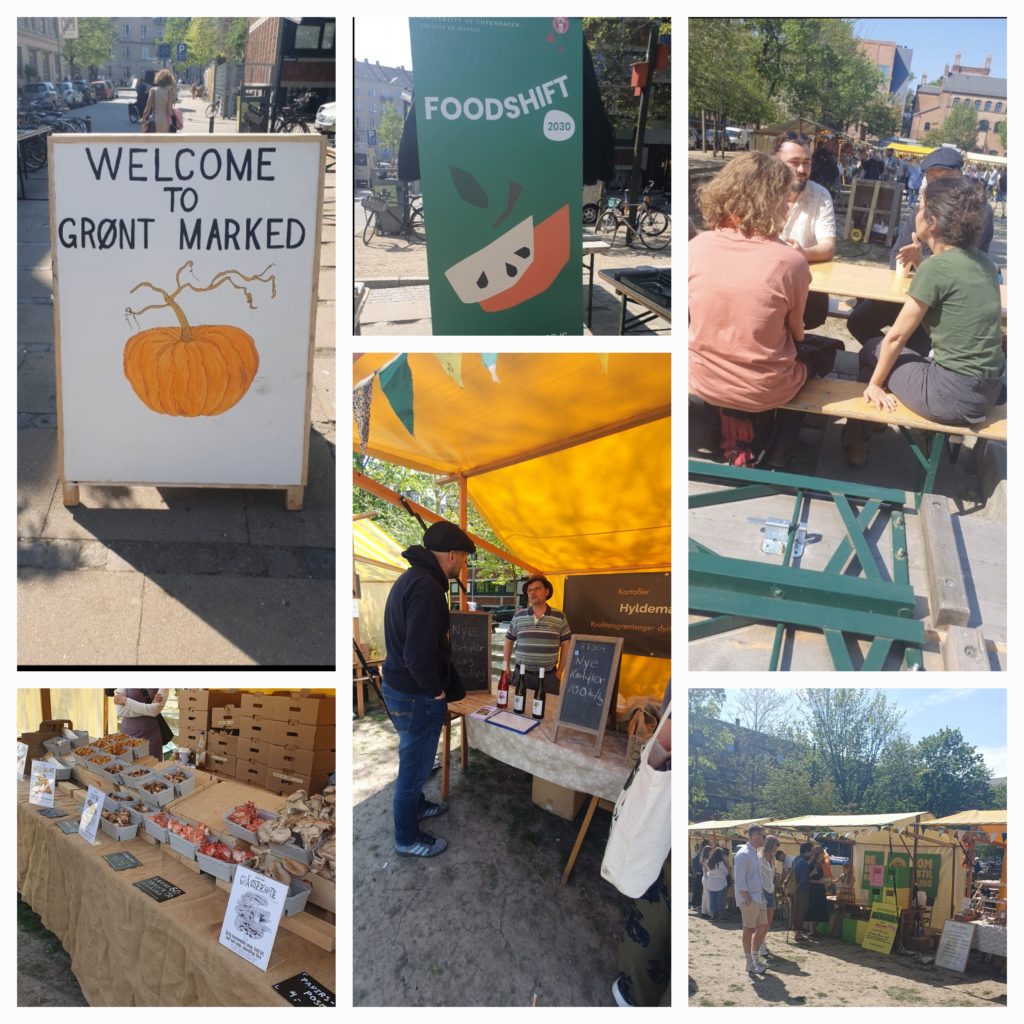
On the first day we visited the farmers market Grønt Market, which was held in one of the many lively and colorful neighborhoods in Copenhagen. Viola Capriola from Grønt Market, one of the CPH FAL innovators, gave a presentation about the farmers market in Copenhagen, the challenges and successes that they have and how they make local, fresh and seasonal food available to everyone, as well as create a healthy and strong connection between the producers in the countryside and the people in the city.
Learnings:
- In order to become a regular shopping place for people like supermarkets are today, Grønt Market are striving to be present in more neighborhoods in Copenhagen. In fact, from August on, Grønt Market can be found in the Frederiksberg area in Copenhagen.
- People in Denmark are not so familiar with the concept of the farmer’s market. To tackle this challenge, they organize workshops and are more vocal on social media about their purpose. Getting more awareness will educate people about the purpose of the market.
After a great presentation and fruitful discussions, the group walked around the farmers’ booths and talked with them about their products, challenges and what works for them.
Learning about public procurement and upcycling of beer from bread
On the second day the study trip continued with a visit to the Copenhagen Hospitality College which trains chefs, waiters and other students for the hotel and restaurant industry. The focus was on how the college works with public procurement, small-scale farmers and organic produce.
Learnings:
- 80% of time is spent in workshops instead of the classrooms
- People from various backgrounds are eager to learn about food – the age ranges from anywhere between 18-56!
- In order to support local, small-scale and organic producers, focus on education is a tender requirement that enables small scale farmers and SMEs to bid instead of conventional firms
The study trip continued with a visit to the upcycling beer and research company Brøl, which is making beer from upcycled organic bread. We learned a lot about production and logistics, but also about the taste of the beer.
Learnings:
- Conventional processes for beer making are not suitable for bread-based beer. Therefore, a lot of hardware and know-how had to be adapted from the Sake industry which is closest to Brøl’s production
- The upcycling business is quite novel, so beer production and research are separate entities in Brøl
The collaboration and knowledge exchange continued with a dinner at Kitchen Collective, including CPH FAL members, the FELs, CPH innovators and advisory board members. Kitchen Collective is a democratic, sharing economy and agenda-setting food entrepreneur house.
They set the stage for food entrepreneurship because they believe that food entrepreneurs are beacons for tasty solutions for a healthier and more sustainable food system. Therefore, a delicious and innovative dinner based on a Japanese concept with Danish ingredients was provided by Saito CPH, one of the entrepreneurs at Kitchen Collective.
Getting to know Coop Crowdfunding and Godis Grønt farm
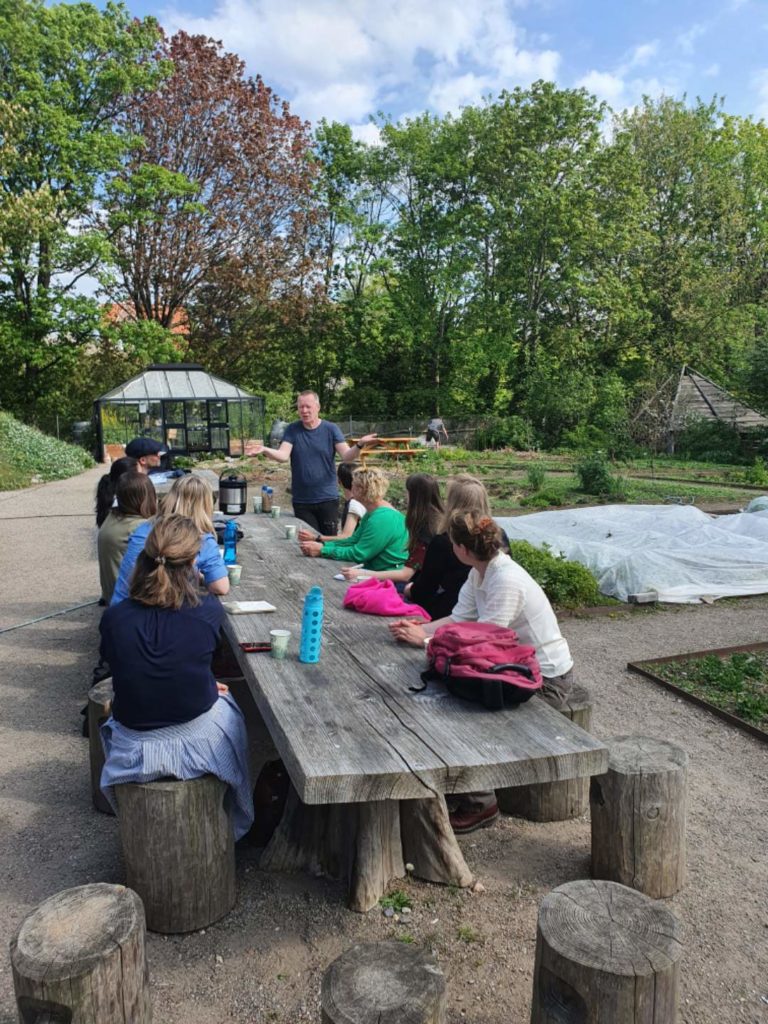
On the last day the visitors learned more about CoopCrowdfunding presented by Nicolai Jæpelt and their inspiring initiatives in Denmark. Coop Crowdfunding is an attitude-based platform that works dedicatedly to promote green change, sustainable solutions and better products across industries.
Learnings:
- Each county has their own laws about crowdfunding; therefore, it is difficult to move beyond national borders. But there are soon common EU policy enabling easy cross-European crowd funding
- Coop crowdfunding has 25 000 users and rewarded 800 projects in 2022. Still, crowdfunding is yet a little-known concept that requires more awareness in the general public
- Main ideas are working towards stablishing reliable partnerships and creating an ecosystem that connects companies and people – all about connection and community
The study trip continued with a visit to Godis Grønt, a small-scale organic vegetable production in Lejre Municipality. Godis Grønt grows nutritious and tasty vegetables and is striving to become more regenerative with time. We learned that they focus on increasing biodiversity and soil health as they grow food for their restaurant and canteen customers as well as for their CSA customers (Community Supported Agriculture). The group had the chance to enjoy plant-based, locally grown vegetables during a delicious lunch made by the people working at the farm.
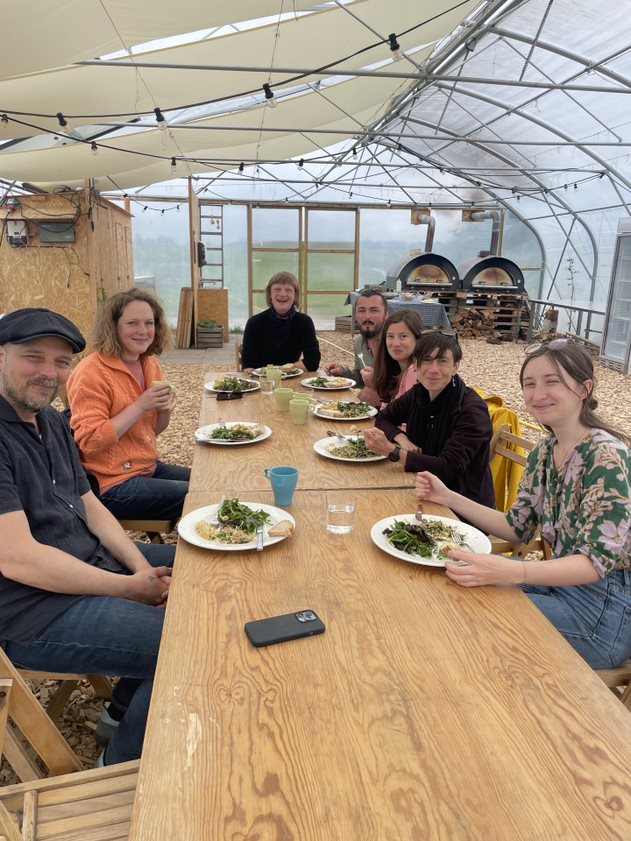
With smiling faces and bellies full of delicious food, it was time to say goodbye to three amazing days full of new knowledge and enlightenment in how the food system works in Copenhagen. The main objective for this study trip was to submerse FELs in the food scene in Copenhagen. They had the chance to learn more about the food scene in Copenhagen, the daily work of local producers working in rural areas, how upcycling businesses work and how public procurement is managed by a college with long-lasting experience in creating future chefs. To conclude, we learned that there are many challenges, but being passionate, dedicated, hardworking and determined can help change the food system into a more sustainable, plant–based and circular one.
Key words: Farmers markets in Denmark, Organic and regenerative farming, CSA – Community Supported Agriculture, (Public) Procurement at Copenhagen Hospitality School, Upcycling, Crowdfunding
Curious to read more about other exhange visits with Fellow Cities? Read about Wroclaw FAL2FEL experience!
The post Exploring the Copenhagen Food System – Stories from our FEL Visit appeared first on FoodSHIFT 2030.
]]>The post Madland & FoodSHIFT setting the stage for the food systems of the future appeared first on FoodSHIFT 2030.
]]>Madland sets the stage for the food systems of the future in partnership with FoodSHIFT 2030
How does an entrepreneurial company approach wanting something as complex as rethinking the food systems? The answer is good cooperation across national borders and value chains. Therefore, since its foundation in 2020, Madland has worked closely with the pan-European change project FoodSHIFT 2030, which was launched by the EU with the ambition to promote a citizen-driven change of the European food system towards a healthy, fair, climate-friendly and more locally rooted future. Read along and get a status and an insight.

Photo credits to: Besøg på Søtofte
Madland came into the world in August 2020 first as a festival and then to establish itself as a food political gathering point that works to rethink the food systems. On a parallel path, the FoodSHIFT 2030 project launched January 2020 and established an Accelerator Lab in Copenhagen. The project has established nine Accelerator Labs in nine different European cities and their catchments, with the task of supporting the development of food system-changing projects. The geographical location and ambition of the project harmonized completely with Madland’s work, which is why the collaboration between Madland and FoodSHIFT 2030 was ideal from the start. Madland is an Innovator under one of FoodSHIFT2030’s four pathways to impact: Citizen empowerment, which is about making food systems more transparent, so that all food citizens have the opportunity to make well-informed decisions about the food they eat, as well as clarifying the influence they can have on, how food is produced, redistributed and recirculated. So what have we created together to equip curious food citizens as well as food professionals for a greater commitment to take part in the change?
Transition from conference to digital engagement
The first area of cooperation should have been an international conference in Copenhagen in September 2020. The pandemic and shutdown canceled the meeting, but meant the start-up and testing of digital formats such as podcasts and magazines. The digital magazine Madlandskaber was published in November 2020 with several digital formats that involved and showcased some of those in Copenhagen and the surrounding area who work with food system change. As part of the magazine, FoodSHIFT2030 and Madland also published the first two episodes of the Madland Podcast, Regenerative Agriculture with Sandra Willumsen and Circular Transformation with Karin Beukel.
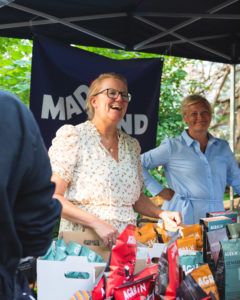
Photo credits (on the right side): Rasmus Poulsgaard
The two formats made it possible to create interest in some relatively complex topics connected with food system change, which would otherwise have been difficult to create interest and engagement around via more concise formats. The newly created interest was an indication that these were formats that both FoodSHIFT2030 and Madland could continue to work with in the coming years’ activities. Therefore, we also decided to publish another edition of Madlandskaber in 2021 and another episode of Madland Podcast, conversion to local ingredients in restaurants and canteens with Line Rise Nielsen.
Gathering point for meetings, media and knowledge FoodSHIFT 2030’s experts and innovators have naturally taken part in Madland’s meetings. First for the opening of Madland and Madland Festival and at the other openings of Madland Festival 2021 and 2022, where i.a. FoodSHIFT 2030’s Lab Leader in Copenhagen, Line Rise Nielsen, through speeches and hosting, has given food citizens an insight into how to work across Europe with the most important food agendas on the menu. Right from the start of Madland Koalitioner in June 2022, FoodSHIFT 2030 has acted as a significant contributor by supporting the program, while several of FoodSHIFT 2030’s Innovators have become part of Madland Koalitioner.
This applies to Coop Crowdfunding, Changing Food, CPH Food Space, Foodprint Nordic, Kitchen Collective and Pantrii. Madland has also taken the pan-European insight into the Madland Guide, where both the Madland Newsletter and SoMe channels have highlighted FoodSHIFT 2030’s webinars and events. Madland has also made it possible for FoodSHIFT2030 to become visible in the press and media, both in the form of press efforts in connection with festivals and public meetings, and mention of the opening of FoodSHIFT2030 and a debate article published in POV International.
Curious about more? Read Madlandskaper here and listen to the Madland Podcast. Like the three previous years, FoodSHIFT 2030 will be a significant part of the Madland Festival in 2023. It will take place 20-23 April. Follow FoodSHIFT 2030 and Madland’s channels for more info!
Discover the Madland Festival for 2023 HERE!
The post Madland & FoodSHIFT setting the stage for the food systems of the future appeared first on FoodSHIFT 2030.
]]>The post A participatory tool for assessing land footprint in city-region food systems—A case study from Metropolitan Copenhagen appeared first on FoodSHIFT 2030.
]]>The ongoing COVID-19 pandemic has exposed the fragility of current food systems to feed populations around the world. Particularly in urban centers, consumers have been confronted with this vulnerability, highlighting reliance on just-in-time logistics, imports and distant primary production. Urban food demand, regional food supply, land use change, and transport strategies are considered key factors for reestablishing resilient landscapes as part of a sustainable food system. Improving the sustainability of food systems in such circumstances entails working on the interrelations between food supply and demand, rural and urban food commodity production sites, and groups of involved actors and consumers. Of special significance is the agricultural land in close proximity to urban centers. Calling for more holistic approaches in the sense of inclusiveness, food security, citizen involvement and ecological principles, this article describes the use of a new decision support tool, the Metropolitan Foodscape Planner (MFP). The MFP features up-to-date European datasets to assess the potential of current agricultural land use to provide food resources (with special attention to both plant- and animal-based products) and meet the demand of city dwellers, and help to empower citizens, innovators, companies, public authorities and other stakeholders of regional food systems to build a more regionalized food supply network. The tool was tested in the context of the food system of the Copenhagen City Region in two collaborative workshops, namely one workshop with stakeholders of the Copenhagen City Region representing food consultancies, local planning authorities and researchers, and one in-person workshop masterclass with MSc students from the University of Copenhagen. Workshop participants used the tool to learn about the impacts of the current food system at the regional and international level with regard to the demand-supply paradigm of city- regions. The ultimate goal was to develop a participatory mapping exercise and test three food system scenarios for a more regionalized and sustainable food system and, therefore, with increased resilience to crises. Results from this implementation also demonstrated the potential of the tool to identify food production sites at local level that are potentially able to feed the city region in a more sustainable, nutritious and way.
Read and download the complete paper here: https://foodshift2030.eu/resources/
The post A participatory tool for assessing land footprint in city-region food systems—A case study from Metropolitan Copenhagen appeared first on FoodSHIFT 2030.
]]>The post EU FOOD 2030 Project Family, by the numbers! appeared first on FoodSHIFT 2030.
]]>
EU FOOD 2030 Project Family, by the numbers!
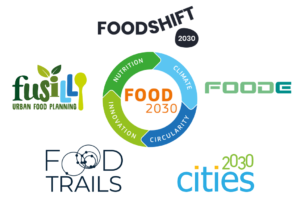
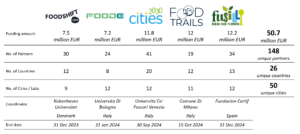
Following up on the previous introduction to the EU FOOD 2030 Project Family and the five founding EU funded projects, FoodSHIFT 2030, FoodE, Food Trails, Fusilli and Cities 2030 comes a ‘by the numbers’ summary of the scale of this international mutli-actor network. Starting with over 50 million EUR being collectively awarded to the five projects from the EU Horizon programme.
The highly diverse, multi-national EU FOOD 2030 Project Family includes over 140 funded partners operating in 26 countries. The five consortia are each different in their structure, but all have the same fundamental need for wide range of partners resulting in the representation of all types of food system actors including; start-ups, SMEs, NGOs, municipalities, governmental bodies, advocacy agents, researchers, collectives, producers, retailers, citizens policy-makers and impact investors.
Of even more significance is the inclusion of 50 unique city-regions in 21 countries that have each received have funding for local innovators, initiatives, and in some cases, living labs. These city regions within the EU FOOD 2030 Project Family are listed below by country:
- The highest representation is 8 Italian city-regions (Bari, Bergamo, Bologna, Milan, Naples, Rome, Turin and Vicenza)
- Next are 6 Spanish city-regions (Barcelona, Castelo Branco, Quart De Poblet, Sabadell, San Sebastian and Tenerife)
- The Netherlands and France each have 4 city-regions (Amsterdam, Groningen, Haarlem and Lansingerland) and (Avignon, Bordeaux, Grenoble and Romainville)
- 2 city-regions for Belgium (Bruges, Ostend), Croatia (Rijeka, Velika Gorica), Finland (Seinäjoki, Tampere) and Germany (Berlin, Bremerhaven)
- 2 city-regions also for Greece (Athens, Thessaloniki), Norway (Longyearbyen, Oslo), Poland (Warsaw, Wroclaw), Romania (Brasov, Ia?i) and Slovenia (Ljubliana, Murska Sobota)
- Finally 1 city-region for Tirana in Albania, Troodos in Cyprus, Vidzeme in Latvia, Differdange in Luxembourg, Funchal in Portugal, Nilufer in Turkey and Birmingham In The United Kingdom.
You can view all of the FOOD 2030 Project Family City-Regions on this map, and, there is plenty more where that came from as these figures are yet to include individual innovators, network organisations nor fellow/cascade cities of which there are many!
Published by Luke Schafer
FoodSHIFT 2030 Scientific Project Manager
https://foodtrails.milanurbanfoodpolicypact.org/
The post EU FOOD 2030 Project Family, by the numbers! appeared first on FoodSHIFT 2030.
]]>The post EU FOOD 2030 Project Family appeared first on FoodSHIFT 2030.
]]>
EU FOOD 2030 Project Family, an introduction
The EU FOOD 2030 Project Family is a collaboration of five EU Horizon projects coordinating synergistic cross-project initiatives towards a sustainable transformation of the European food system aligned with European Commission’s FOOD 2030 and Farm to Fork Strategy.
This collaboration is a self-coordinated approach with project representatives attending quarterly planning meetings with an alternating project host and FoodSHIFT 2030 project hosted the latest EU FOOD 2030 Project Family quarterly planning meeting. Some of the joint cross-project initiatives include under development:
Producing joint webinars where key expertise and best practices from city-regions shared across the five projects and brought to public audiences
Expanding our collective reach by developing cross-project strategies for communication and dissemination and considerations for a joint Horizon Results Booster application.
Maximizing the impact of accumulative project legacy items with considerations for a joint EU FOOD 2030 Project Family Manifesto
Translating FOOD 2030 communications and key project messages into policy directives for the EU in the form of a providing a joint advocacy statement to the European Commission’s Sustainable EU food system initiatives open consultation for legislative framework for sustainable food systems.
This cross-project approach will be active for the foreseeable future and thereafter, it is the ambition that the Project Family is continuously carried forward by newly funded projects. Thus, providing a fundamental link enabling the pooling of synergistic expertise, outputs and tools that increase EU funding efficiency and have greater collective influence on the transformation of the European Food System.
Published by Luke Schafer
FoodSHIFT 2030 Scientific Project Manager
https://foodtrails.milanurbanfoodpolicypact.org/
https://food.ec.europa.eu/horizontal-topics/farm-fork-strategy_en
The post EU FOOD 2030 Project Family appeared first on FoodSHIFT 2030.
]]>