The post FoodSHIFT email forum appeared first on FoodSHIFT 2030.
]]>Stay connected and join the FoodSHIFT+ email forum – the Rise Up email forum for multi-actor food partnerships across Europe and beyond.
Email [email protected] to be signed up by the platform.
Once subscribed, email [email protected] to ask questions or share information and it will be received by the entire list.
Frequently Asked Questions (FAQs)
Who can join this email forum?
Everyone involved in the FoodSHIFT2030 project, including the core project team, the FoodSHIFT Accelerator Labs (FALs), Fellow cities (FELs) and network partners. Multiple people from the same lab, partnership or organisation can sign up to the forum.
As the project comes to a close at the end of 2023, FoodSHIFT + has extended the invitation to all multi-actor food partnerships who have come across the project, attended workshops and webinars, and would like to stay connected with work happening across Europe.
Why join?
FoodSHIFT+ connects all those working across the FoodSHIFT network. It provides a platform for communication and knowledge sharing, a place to share challenges, questions, news and updates relevant to sustainable food systems and multi-actor partnerships.
How does it work?
Knowledge sharing made simple! Once you’re signed up, you receive emails straight to your inbox with no need to log in to check messages.
– To sign up people need to email [email protected]
– Once subscribed you can ask your questions or share info by emailing [email protected] and it will be received by the entire list.
– To unsubscribe from this list, email [email protected].
What can I post about?
You are welcome to share anything related to your project which you believe would be of interest to the rest of the network, including relevant research, insights, and events, as well as particular challenges or questions you might have related to food system partnerships.
Topics might include:
- Questions on specific areas cities, councils, partnerships are struggling with e.g. how/whether to encourage citizen involvement in food partnerships; how to measure emissions saved from improved public procurement, how to work most effectively with businesses in a food partnership, etc.
- Examples of local success, developments you are proud of and would like to share, or need advice on
- Webinars and event news
- New reports and developments from other sector organisations
- International grants available on this theme
- Job posts
- Wider themes such as food governance, food citizen engagement and more
The size limit for messages is 500Kb, which means that users will not be able to share attachments in posts.
How often can I post?
You can post as often as you like, and remember to invite everyone within your local food partnership to sign up!
Will the forum be moderated?
Yes. The moderator will keep an eye out for posts that violate the forum’s user guidelines. Any such post will be removed by the moderator.
Can I use the forum to communicate with my assigned FoodSHIFT project partner?
No. This forum is not for sharing detailed project work and sensitive documents that relate to specific bilateral or multilateral work streams between FAls and FELs. This is not an internal communication channel to carry out FoodSHIFT related project work.
Can I use this forum as an archive and list/search materials for FoodSHIFT legacy work?
No. This forum does not work as a library of materials. It is not a mini site or a shared drive. When someone posts in the forum, you will receive an email but there is no website or page for you to access to search back for previous posts unless you have saved the emails personally.
User Guidelines
No Spam / Advertising / Self-promotion
This forum defines spam as unsolicited advertisement for goods, services and/or other web sites, or posts with little, or completely unrelated content.
Do not post copyright-infringing material
Providing or asking for information on how to illegally obtain copyrighted materials is forbidden, this also includes internal and confidential FoodSHIFT 2030 documents such as the Grant Agreement or Consortium Agreement
Do not post “offensive” posts, links or images
Any material which constitutes defamation, harassment, or abuse is strictly prohibited. Material that is sexually or otherwise obscene, racist, or otherwise overly discriminatory is not permitted on this forum.
Remain respectful of other members at all times
All posts should be professional and courteous. You have every right to disagree with your fellow community members and explain your perspective. However, you are not free to attack, degrade, insult, or otherwise belittle them or the quality of this community.
The post FoodSHIFT email forum appeared first on FoodSHIFT 2030.
]]>The post Citizen Driven Innovation in the food system appeared first on FoodSHIFT 2030.
]]>IB#1 Citizen Driven Innovation in the food system
Exploring the importance of citizen driven innovation in the food system
As part of food system transition, all relevant stakeholders should be actively engaged and included in the development of a sustainable food system on economic, ecological and social levels. Among these stakeholders, there is one target group that is often overlooked, but can be essential to creating a fit for purpose food system: the citizens.
In city regions in particular, citizens can experience a large sense of distance between the food they consume and where it has come from. This can be exemplified by the long and complex food supply chains that are commonplace in our food systems, meaning that consumers (who are first and foremost citizens), often experience the food system in a passive role towards the end of the supply chain. However, in order to develop a food system that is truly sustainable, citizens must also be encouraged and empowered to take on an active role in the food system. This will require targeted efforts from other food system stakeholders to integrate citizens into their planning, strategy development and activity implementation.
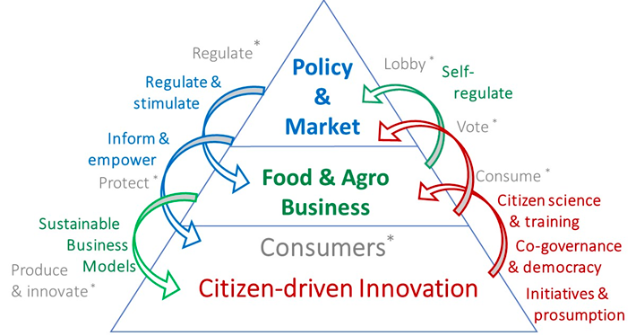
Figure 1: Citizen-driven innovation model with citizens as drivers of the food system in colour; current/mainstream food system functions in grey and marked with *.
The FoodSHIFT2030 Innovation Brief #1 (IB#1) explores the different levels of citizen engagement in the context of food system innovation. Figure 1 illustrates that the action-field of citizen-driven innovation as part of the wider food system stands at its very bottom but is impacting on both the food/agro industry as well as the policy and market regimes. The colour scheme differentiates traditional role divisions (e.g., citizens mainly as consumers) in contrast to emerging action fields such as engagement in citizen science, co-governance and prosumption – the latter pointing at food production in form of community gardens, home-growing facilities (vertical farming) and other concepts.
The Innovation Brief presents real-life examples of citizen driven innovation from the FoodSHIFT 2030 project, interpreting them according to a selection of key characteristics as follows:
- Type of citizen driven innovation
- Level of citizen involvement
- Financial viability
- Upscaling & optimisation
With these characteristics in mind, we can explore opportunities for citizen driven innovation and begin to evaluate the potential of these innovations for food system transition, and the inclusion of citizens in that process.
Curious to learn more about citizen driven innovation? Read the full Innovation Brief here or reach out to [email protected] if you have further questions or visit https://www.susmetro.eu/.
Download the FoodSHIFT2030 Innovation brief #1 or go to our resources section.
Key words: Food system, innovation, citizen engagement, citizen empowerment, city regions, urban food system
Authors: Poppy Eyre, Dirk Wascher & Gustavo Arciniegas
Would you like to know more about how to empower citizens towards more sustainable food sytems and food strategy to do so? Then check out this article!
The post Citizen Driven Innovation in the food system appeared first on FoodSHIFT 2030.
]]>The post Empowering citizens towards more sustainable food systems appeared first on FoodSHIFT 2030.
]]>Transforming our food system to address urgent challenges such as unhealthy diets, malnutrition and undernutrition, insufficient reduction of GHG emissions and a widening urban-rural gap is necessary. Citizens play a crucial role in this transformation, for example through their increasing demand for healthy and more plant-based food, engaging in food related NGOs, setting up food sector SMEs and grassroots organizations, influencing the food system in their city-region by engaging in local food strategies and policies, etc.
The FoodSHIFT2030 project aims to empower citizens to take up an active role as co-stakeholder and decision-maker in the food system. To reach this goal, a ‘Citizen Empowerment Scheme’ was developed by ILVO (Flemish Research Institute for Agriculture, Fisheries and Food; Instituut voor Landbouw-, Visserij– en Voedingsonderzoek – ILVO Vlaanderen); a guideline that outlines different steps and actions local governments, research institution, local food initiatives and citizens can take to facilitate this role.
First things first, what is citizen engagement and empowerment?
Citizen engagement or participation is about getting local people involved in the decision-making process of a local government. Citizen participation is the basis for a thriving democracy: when people get involved in and support political decisions, they begin to feel responsible for what goes on around them. There are different levels of citizen participation, ranging from low level influence to high level influence on decision-making:
- Informing: local government informs citizens with transparent, up-to-date information. The public is not actively involved in decision-making.
- Consulting: asking local people for quick or detailed feedback about their views and ideas about governmental decisions or plans via, for example, polls or surveys.
- Involving: when local people are involved this means that there is some form of active involvement of citizens within?the activities of a local government. It concerns a two-way flow of communication (government and citizens) and the active input and actions from citizens.
- Empowering: to support citizens with knowledge and vision building, and/or financial resources for them to actively take up a role in policy decisions.
It is clear that empowering is the highest level of citizen engagement and highly valuable but isn’t always realistic for a city-region.?
Role of digital platforms in improving a city-regions’ initiatives for citizen engagement
Many cities have launched a digital platform where local residents are informed about and (sometimes) can participate in the political decisions made by a city-region. Such a platform makes it possible to engage and give a voice to many residents of a city, since often?residents want to participate in public decision-making but are largely unfamiliar with the ways of how to do this. A digital platform can overcome this barrier.?Some examples of platforms within the FoodSHIFT partners: Berlin has the ‘mein Berlin’ platform (mein.berlin.de — meinBerlin), Barcelona has the platform ‘Barcelona Sostenible (bcnsostenible.cat), Ostend has the platform ‘ Burgerparticipatieplatform van Stad Oostende | CitizenLab‘.
Role of citizens in transforming our food system
Several European partners within the FoodSHIFT project have set up a citizen engagement process to reach their food (policy) goals. In this article, we will highlight one case example of the city of Ostend – Ostend Lab where the different levels of citizen engagement are addressed. There are many other case examples, which can be found in the Deliverable 6.1 ‘Citizen Empowerment Scheme’ and also in the Innovation Brief #1 – Citizen Driven Innovation.

Photo credits: Nick Decombel
The city of Ostend has put the theme ‘food’ on top of their political agenda. They have recently launched a food strategy named ‘Oostende Oogst’ which takes up relevant themes such as short supply chain, food waste, social inclusivity, establishment of a food council and improving food literacy. They also have a food- and agricultural park ‘Gardens of Stene’ for citizens and visitors of Ostend, which brings people closer to locally grown food (fruit, vegetables, meat) and provides outdoor space for recreation and education (e.g., a consumer supported agriculture (CSA), cooking workshops and social inclusive food events.) To reach their food-goals, the gardens of Stene receive support from the city?and actively collaborate with different local food stakeholders of Ostend.??
The city of Ostend covers different levels of engaging citizens for the operationalisation of their food strategy and activities in the agricultural park.
The food strategy ‘Oostende Oogst’
For the launching of the food strategy, the city has sent a seed bag (to grow vegetables) accompanied with information on the food strategy to all residents of Ostend. They also communicated via social media (website & Facebook), local newspapers and several press moments (level informing). In addition to this process of informing, a two-step approach was taken with the goal of engaging citizens more actively within the food strategy.?
- In a first step, a citizen survey was developed to question the inhabitants of Ostend about the theme of food. The survey questioned their knowledge and general impression of the agricultural park, their awareness of the food strategy and whether they want to be actively involved in the food strategy. The goal was to first identify those citizens with a special interest in food-related issues (cooking, growing, sharing) in order to later involve them more actively in collective sustainability action.? The survey was launched via their online platform ‘ons.oostende.be’ but also followed up through personal outreaching work?(e.g., on the farmers’ market in Ostend). The aim of the latter was to also reach citizens who are not aware of the online platform. The results of the survey were communicated via the online platform and the city’s website (level of informing, consulting and involvement).?
- In a second step, those citizens that had indicated to be interested in being actively involved in the food strategy were invited to a workshop. The event was also announced on the online platform, so all who wanted could participate. The goal of this event was to inform the local residents on the existing projects and food initiatives (civic initiatives, social non-profit organizations) linked to the food strategy, with a request for citizen participation. Dialogue tables were organized to harvest ideas and actions linked to the food strategy, but also to help local residents in launching their own food initiative (level of informing, collaboration and empowerment).

Workshop on Food Strategy in Ostend
Food- and agricultural park ‘Gardens of Stene’
- They organized four city-dialogues (on inspiration, discussion, discussing plans and presenting plans) during the planning phase until the actual establishment of the agricultural park. Citizens could provide their ideas and views and discuss different options for the facilities and the design of the park. Residents, users, farmers and owners of the agricultural park were invited (level of information and involvement).
- They informed the citizens about the establishment of the agricultural park via a festival, via the kick-off event of the FoodSHIFT project and via different communication channels (social media, website, press releases). They also developed four infomercials on the park for the target audiences: schools, visitors, surrounding residents and actual users of the park. This was distributed via social media and the hospitality organization ‘Tourism Ostend’ (level of informing).
- Currently, the park has a community supported agriculture (CSA) (type of farming where members pay an annual fee in return for fresh organic vegetables all year). The members are actively involved in the farmer activities on a voluntary basis and can give input on which type of vegetables to be grown and participate in all kinds of cooking activities (level of consulting and involvement).
Blueprinting the future: what’s next?
Despite these very promising and successful examples, challenges arise in relation to the process of citizen engagement. Based upon the best practices in the FoodSHIFT2030 project, we summarize some of the main challenges and tips to be considered for the engagement of citizens in public decision and to empower citizens to change the food system.
Always inform citizens first. There are four different levels of engaging citizens in a city region. It is, however, highly important to always start with the lowest level: informing. Very often, the knowledge and awareness among inhabitants of a city region related to food activities and initiatives is low, or nonexistent. When there is no knowledge or awareness, there is no way you can optimally engage citizens in public decision making. Especially when it concerns difficult or abstract topics, such as food tech, to avoid biases or misunderstanding (example: food tech is sometimes seen as a luxury good). Also, when people do not know their city has a food strategy or policy, they will not be able to relate their own actions to this larger framework.
Vision alignment within the municipality. Make sure that the departments within a municipality have the same vision on the topic of food. A system-thinking exercise can be very useful to do so. It is the responsibility of a municipality to support food initiatives within their city-region. When there is an internal conflict within a municipality, these food innovators and their innovations cannot receive full support. Food innovators are usually supported by and collaborate with a large group of citizens. Food innovators are thus an important vehicle to engage with a group of citizens and therefore support of the municipality is important.
Reach the not so usual suspects. Often, when a city-region or a food initiative wants to engage citizens, only the usual suspects or citizens familiar with these forms of participatory processes participate. How do you reach citizens that you usually do not reach, or give a voice to more residents of a city (including the vulnerable)? This remains a million-dollar question in many of the discussions concerning participatory processes. There are a variety of ways that can help you with this:
- Adapt communication and language to your target audience(s) (for more information see the Deliverable 6.1)
- To reach vulnerable groups use fieldworkers/initiatives (e.g., streetworkers, social food initiatives), who have daily contact with vulnerable groups to inform them on citizen participation projects.?
- Accept that not all citizens want to be involved – put your effort into those who want to be engaged.
- Make and keep in contact with local media (newspapers, TV, radio). When they find a topic interesting, they can make a TV report, a podcast or an article. This reaches a larger audience, making it easier for citizens to participate in a project.
The most pressing challenge is that citizen engagement often depends on political party and legislation. If it is not a top priority on the policy agenda, then it’s difficult to set up such a process – at least for public decision making.
To conclude, we highlight the role of different actors to stimulate citizen driven food systems. What thrives citizen driven food systems? For one, it can be municipalities engaging themselves in EU projects. Projects such as FoodSHIFT2030 are important to anchor food as a theme in a city-region (regardless of the legislative party). Such projects can be a kick start toward developing citizen driven food strategies and food policies and be continued after the project. Means for local citizen participation should be embedded in each project. Second, the role of universities and research organizations to support cities in citizen engagement. Collaboration between different actors (municipality, food initiatives, research) is important to establish citizen driven food systems.
Keywords: citizen empowerment, food system change, food strategies, food system transformation, citizen involvement, citizen participation, citizen engagement
Would you like to know more about real-life examples of citizen driven innovation? Check out this article about the Innovation Brief #1.
The post Empowering citizens towards more sustainable food systems appeared first on FoodSHIFT 2030.
]]>The post Food Tech 3.0 Updates: GitBook coming soon! appeared first on FoodSHIFT 2030.
]]>![A screenshot of the Food Tech 3.0 GitBook webpage is open to the community sub-section titled, “What is a community & how do they function.” It includes a still of Food Tech 3.0’s recent webinar on Transforming the Food System from Communities in which two people are interacting around food next to the title ‘Mutual Food Assistance’]](/wp-content/uploads/2023/05/gitbook-image-better-1024x556.png)
The Food Tech 3.0 GitBook is under development! We’re looking forward to releasing the GitBook in June in time for our workshop at the re:publica Festival in Berlin.
At the Food Tech 3.0 FAL in Barcelona, the Fab Lab Barcelona team is developing a new tool on how makerspaces, Fab Labs and Fab Cities can support the development of food initiatives, including tools and best practices for innovators and communities. This resource is a compilation of inspirations, learnings, examples, interactive tools, and furthering conversations around food technology. It is presented as an interactive online book, on the platform GitBook, which keeps in line with both the Food Tech 3.0 and Fab Lab Barcelona values of open source and freely accessible.
Target Audience: Who do we envision using the GitBook?
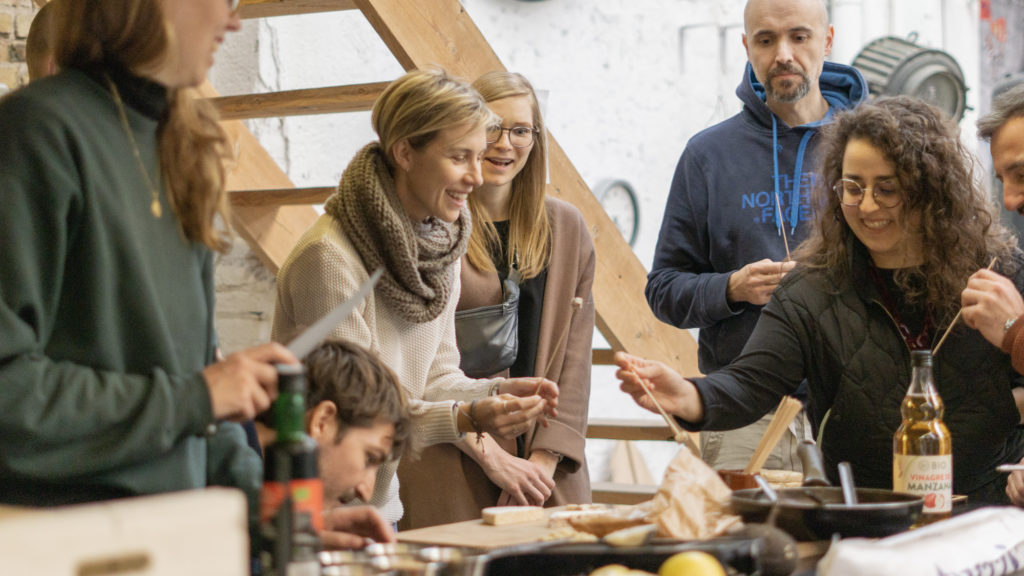
Members of the Food Tech 3.0 FoodSHIFT Enabler Lab joined a workshop presented by Food Tech 3.0 innovators, Domingo Club. Workshop participants represented various stakeholder groups that the GitBook aims to target.
The Food Tech 3.0 GitBook is imagined to serve a variety of audiences. We believe it has information and resources for:
Citizens:
- We hope this resource serves to help you imagine a present in which food technology is an accessible asset you can use to produce, consume and recycle food yourself.
Communities and civil society:
- We hope it can serve as an entry point for connecting you to food technology that might meet your needs.
Food technology makers and small businesses:
We hope it gives you ideas on how you might engage with tenets of food citizenship and citizen-driven innovation, open source, holistic sustainability, justice and equity and working ecosytsemically.
Policy makers and municipality workers:
- We hope the GitBook can inspire you to continue supporting alternative food technologies and local food communities and to understand how and why to support the innovative work of makerspaces, Fab Labs and Fab Cities at this intersection
And finally, for makerspaces, Fab Labs, & Fab Cities:
- We hope the Food Tech 3.0 GitBook helps you understand the potential role our spaces can play in advancing food technology for a citizen-driven, regenerative, and ecosystemic food system transition
Food Tech 3.0 GitBook Features
The GitBook includes a wide range of resources, from visions of the future to community tools, webinars on food tech to examples of platforms empowering food communities. Some of the key features in the GitBook include:
? Understanding what food technology means for Fab Lab Barcelona and Food Tech 3.0
? Why and how makerspaces, Fab Labs & Fab Cities can support food technology initiatives and their communities
? A look into how Fab Lab Barcelona identified, matured, combined, and upscaled food technology initiatives and tips for makerspaces looking to do the same with their own local communities
? Best practices and interactive tools to support innovators and communities approach Food Tech Accelerator Program’s pillars: community, technology, and business.
? A series of conversations with professionals in the field ranging from how to create a shift in consciousness in order to create a paradigm shift in our food system to how initiatives can integrate collaboration into their work from the very beginning
? Examples of food tech innovators putting this all in practice, including examples from our Food Tech 3.0 Enabler Labs (FELs): Fab City Hamburg (Hamburg, Germany); Fab City Grand Paris (Paris, France); Open Dot Lab (Milan, Italy).
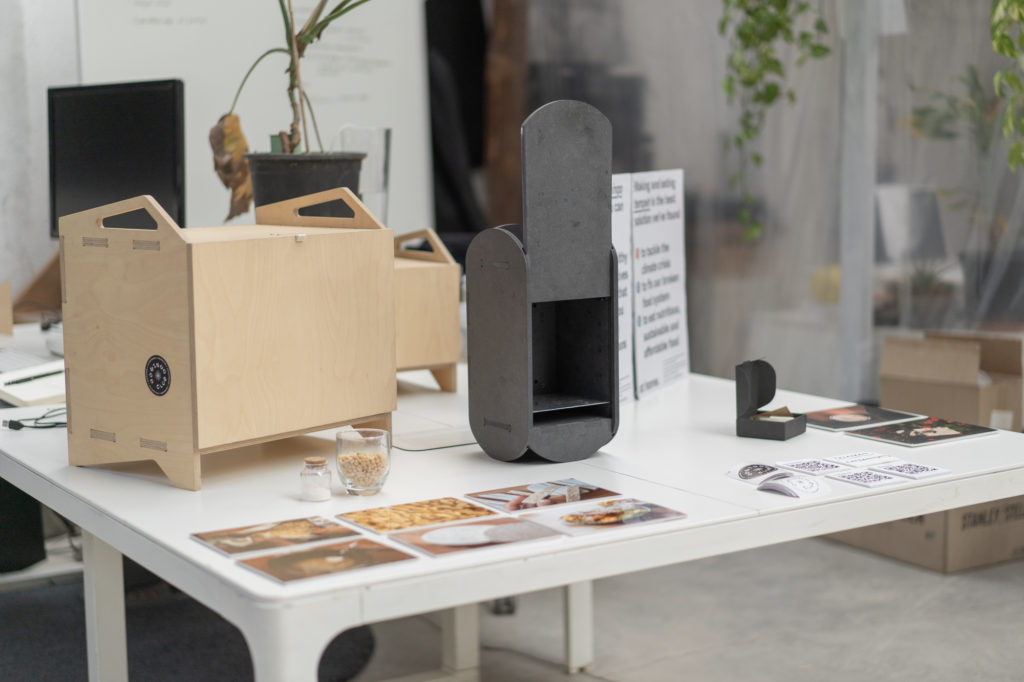
The Domingo Club Incubators during a recent workshop with the Food Tech 3.0 FELs in Barcelona.
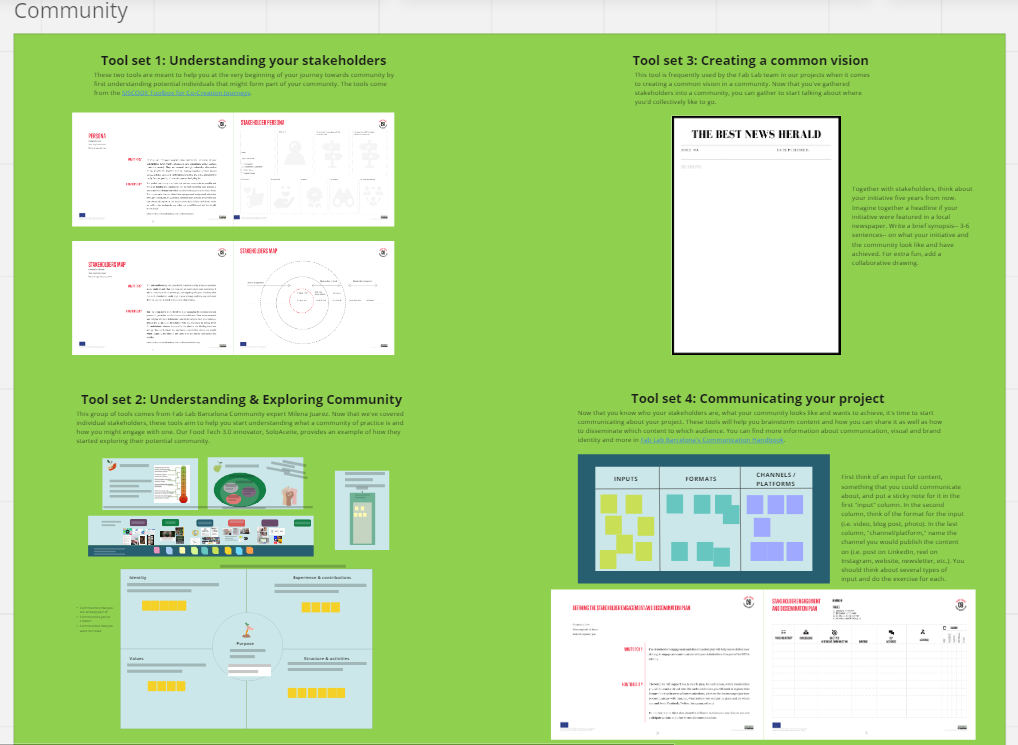
Screenshot of the tools for understanding communities. The tools are hosted on MIRO and the templates can be copied by users to help them identify, understand, grow and communicate with their communities.
How you can get involved
The Food Tech 3.0 Gitbook’s planned release is for June, though the resource is a living document and will continue to be updated with new findings, approaches, and best practices.
But there are two exciting things you can do while you eagerly wait its arrival:
?? If you’re interested in learning more about Food Tech 3.0’s approach and the upcoming GitBook, you can register for the “Envisioning distributed food hubs with citizens, Fab Labs & Fab Cities” workshop, which will be part of the re:publica festival in Berlin this coming June 5th-7th. During the workshop, participants will use a future design tool and the Food Tech 3.0 GitBook to explore how to harness makerspaces, Fab Labs or Fab Cities to create a distributed network of social food hubs. The workshop is geared toward citizens who want to reclaim our food system, food innovators who are designing ways to do it, and makerspace, Fab Lab or Fab City participants that design spaces to recuperate the food system.
For the workshop, the Food Tech 3.0 team will join forces with the Distributed Design Platform, an exchange and networking hub for the emerging field of distributed design. Distributed Design Platform is also an EU funded project.
? You can also join the #food channel on the Distributed Design Platform’s Discord, where we’ll keep exchanging about how we can make citizen-centered, regenerative food tech together with the Distributed Design Platform’s community! (This channel will be used instead of Food Tech 3.0’s original Discord, so make sure to migrate to the new space.)
?? Help us map the Food Tech x makerspace ecosystem by participating in the mapping survey, which you can find here. Participants may be featured in the GitBook or shared about on the #food discord channel.
? And of course, check in with Fab Lab Barcelona to stay up to date on our food journeys!
We cannot wait to share the Food Tech 3.0 GitBook with you! Stay tuned for more ?
The post Food Tech 3.0 Updates: GitBook coming soon! appeared first on FoodSHIFT 2030.
]]>The post Citizen engagement is about meeting where people already are appeared first on FoodSHIFT 2030.
]]>Citizen engagement is about meeting where people already are, finds latest FoodSHIFT workshop
Recording of Food Citizenship and Building Engagement workshop
engaged with the process. In a helpful analogy, Maarten said the minimum organisations can do if they wish to engage citizens is to ‘put a meal on the table, make that meal appealing, and make sure that meal is connected to a wider system for providing concrete options for participating in that meal’.
– Finding farmers in city regions to supply food locally
– Enrolling a wider circle of citizens beyond those who started the initiative
– Finding a balance between participatory and demoratic approach, vs economic efficiency
– Transfroming structures of citizen initiatives into more formal organisations with public
funding is hard when wishing to maintain some of the initial foundational values
– Communicating and building a relationship between munipalities and citizens
– Funding and investments, and access to land
– Low tech
– Innovative ideas when looking at facilitating access to land access, for example
municipalities could contract farmers
– Development of a social business model, to secure long term funding
– Back any pitch with research, facts and data to rasie long term funding and make your
initiative more attractive
– Link up with other cities and other actors
the Sustainable Food Places Growing the Good Food Movement toolkit.
The post Citizen engagement is about meeting where people already are appeared first on FoodSHIFT 2030.
]]>The post Multiplying the impact – sharing experiences: Peer-to-peer learning in FoodSHIFT2030 appeared first on FoodSHIFT 2030.
]]>Keywords: peer-to-peer learning, knowledge transfer, network
The peer-to-peer learning approach is learning at equal level, where people with similar tasks, aims or challenges share experiences, ideas and knowledge with each other without hierarchies.
Peer-to-peer learning in FoodSHIFT2030
There are many peer-to-peer learning formats, some of which have been gathered within FoodSHIFT2030 in deliverable 5.3 under the title “Multiplying the impact – sharing experiences: training and guidance materials for knowledge transfer”. This collection primarily addresses the FoodSHIFT2030 Accelerator Labs (FALs) and aims to facilitate peer-to-peer knowledge transfer of experience with food system innovations among all FALs as well as among the FALs and the FoodSHIFT2030 Enabler Labs (FELs). However, it can also serve as a diverse source of inspiration for actors in the field of mutual knowledge transfer beyond the project’s lifetime and thematic scope.
The document is available for download in the “resources” section of FoodSHIFT’s website among various further inspiring outputs of the project: https://foodshift2030.eu/resources/.
On the one hand, the material contains peer-to-peer learning formats in general description which can be applied in a variety of situations and knowledge transfer environments. On the other hand, there are knowledge transfer formats that were developed or/and applied specifically within the FoodSHIFT2030 context.
It is an elementary aspect that not only the knowledge transfer formats themselves follow the peer-to-peer approach, but also the compilation of the material took place in co-creation, a collaborative process of knowledge generation: hereby, the FALs generated knowledge for each other, such as good practice cases from within the project as well as specific training material from a FAL’s individual experience. Further, in an iterative bottom-up approach which required the intensive involvement of the FALs, their needs, strengths and challenges were identified, for instance during consortium meetings, in interviews and in brainstorming sessions.
Thus, in the spirit of peer-to-peer learning, most of the training and guidance material was not unilaterally created by FoodSHIFT’s WP5 team for knowledge transfer but arose from the condensed outcomes of these assessments. The WP5 team, the knowledge brokers, hereby guide this knowledge generation to ensure that the knowledge is being transferred within and beyond in formats suitable for the respective target groups.
An exemplary format: a series of video interviews
In addition to the tools for networking, information, and knowledge transfer, as well as best practices and implementation examples from FALs and much more, the collection includes a series of video interviews in which FALs have their say:
Recorded at the consortium meeting in Brasov, they spontaneously talk about their innovation principles as well as their experiences in the project with a focus on the interaction with the FELs with whom knowledge transfer and experience sharing is taking place very specifically within the project.

© Annika Frühbeißer
In addition, an introductory animated video has been created that explains a little about the FALs and their activities in FoodSHIFT2030. You can find the four video interviews and the introductory video on the YouTube channel of FoodSHIFT2030 in the playlist: Exchange visits: Knowledge Exchange FAL to FEL.

© Annika Frühbeißer
Shooting and editing video requires some training, and a course is recommended. However, if once the necessary know-how has been acquired, all you need is a smartphone with a stabilisator (a so-called gimbal), a filming and editing app as well as a clip-on microphone to professionally produce your own videos.
Videos are establishing as a knowledge transfer format since they correspond to the zeitgeist and offer many advantages:
- Knowledge can be conveyed in a highly compressed and easily understandable way through video content.
- In addition to real-filmic elements, animation elements allow creative freedom and add a framework and structure to a video; for instance, we used the simpleshow.com programme in FoodSHIFT’s videos.
- Knowledge can be accessed freely at any time, the knowledge flow can be paused and repeated if the videos are published on public platforms such as YouTube or a project website.
- Onward dissemination by the viewers, even on a large scale, is low-threshold and can have a great impact (social media).
- And last but not least, it is great fun to talk to your peers and gain new insights whilst you are shooting the videos!
Watch the series of video interviews here below:
The post Multiplying the impact – sharing experiences: Peer-to-peer learning in FoodSHIFT2030 appeared first on FoodSHIFT 2030.
]]>The post Innovators: Meet the people changing your food system appeared first on FoodSHIFT 2030.
]]>In these portraits, each of the 90 innovators has been profiled using compact descriptive section addressing the key activities and achievements so far as well as the near future perspectives under the heading ‘Looking ahead’. The one-page portraits are complemented by infographics on the impacts and the relevant contact details.
For quick orientation, the innovations have been categorized according to four innovation dimensions: product, process, social & governance. These dimensions enable us to identify what kind of innovations are being initiated across city regions and provide suitable, relevant support.
These rich examples give us a glimpse of how food system innovations can look, and how they can be effective in addressing elements of the food system, and the relevant stakeholders that are involved. Together, these innovators and related stakeholders form the Innovation Ecosystem in their city-region, which has the potential to redefine local food systems.
Supporting Innovations
In addition to these differing innovation dimensions, the Innovation Portraits also highlight the varying maturity levels seen among innovations. This maturity refers to the developmental stage of an innovation, which can be useful in identifying the needs and next steps that an innovator can take to bring an idea to life, from Eureka! moment to viable product or service.
Based on the maturity of an innovation, we can establish what kind of support would be best suited to the innovator. This support takes three main forms:
Maturing – advancing an innovation for better application as a solution. E.g. improved functioning of the innovation, better organizational structure, developing a business strategy…
Combining – linking of different innovations for strategic purposes. E.g. partnerships to facilitate new services, resource sharing, collaboration towards a common goal (coalitions, associations…)
Upscaling – increasing the impact and/or outreach of an innovation. E.g. increasing production, adding new products or services, outreach to new markets or communities, open-source knowledge sharing…
The Innovation Portraits provide us with an important reflection of the food system transition, in that many innovations are still early on in their maturing process, and in addition to the passion and ambition of the innovator themselves, will require targeted support and enabling conditions to thrive.
Providing us with snapshots of diverse innovators per city region, the Innovation Portraits also offer us an opportunity to consider how the Innovation Ecosystems in these city regions look. For example:
- Which innovators have (potentially) complementary resources, products or services?
- Which partnerships can be formed?
- Which innovators have a common interest or goal?
In particular, these questions can open the door to opportunities for combining, stimulating activity in the local Innovation Ecosystem. Looking at long-term perspectives, upscaling is a key acceleration mechanism for innovations that are at a high level of maturity and wish to increase their reach and impact.
Discover all INNOVATORS at a glance here!
Opportunities for Change
The 90 cases highlighted by the Innovation Portraits provides not only an inspiring portfolio of the diverse innovations that are actively contributing to food system transition, but also an example of how individual action, by individual innovators, can kick-start the development of an innovation ecosystem. These innovation ecosystems are fundamental in challenging the status-quo of food systems, and can generate awareness, interest and engagement with change. Through supporting the innovators highlighted in these Innovation Portraits, the FoodSHIFT2030 consortium hopes to accelerate the transition to a low-carbon, circular and plant-based food system in Europe.
Download the Innovation Portrait brochure here.
The post Innovators: Meet the people changing your food system appeared first on FoodSHIFT 2030.
]]>The post How to cook up civic-driven food system governance? A step-by-step guide for practitioners appeared first on FoodSHIFT 2030.
]]>A step-by-step guide for practitioners
Key words: food system governance, food strategy, guide, methods and tools
? Read and download the complete guide in the resources section: “Infopackage on good practices and evaluation criteria for citizen-driven food system governance“.
Many city-regions across Europe are asking themselves how to improve their local food policy, how to engage stakeholder and how to develop and implement actions for a food system transformation.
To address these questions, FoodSHIFT has created a step-by-step guide for practitioners to create their own recipes for civic-driven food governance. The guide presents the governance approach towards food system transformation taken by FoodSHIFT and helps the reader to become more familiar with key concepts and processes of developing a food strategy.
The reader is guided through each step for developing a food strategy (i. Initiation, ii. Assessment, iii. Stakeholder Engagement, iv. Vision Building and Action Planning, v. Evaluation), which come with templates, exercises and additional material to support a participatory and deliberative process. However, the process, steps and methods presented in this guide are not limited to building a food strategy, but can be useful for many different food system initiatives.
Initiation – The Power of Storytelling
At the beginning of the process comes often the question “Why?” Why to develop a food strategy? Why now? Why at city level, which has nothing to do with agriculture?
To communicate the relevance of a local food strategy (or other food topics), storytelling can be a powerful tool. It is through stories that we simplify and make sense of complex topics or motivate others to act. Stories help us to identify problems and solutions and to understand why something is happening. Stories covey assumptions and believes, which influence the rules that define our economies, policies and societies. However, stories not only help us to increase our awareness and make sense of something, but also help to rewrite “realities”; they generate new visions and ideas, stories engage the listener and motivate people to act. The guide provides resources for creating and telling food stories.
Assessing – What‘s on the radar?
In order to know what needs to change, it is important to understand the current situation. Without a baseline increases the risk of spending a lot of time and resources into ineffective actions and policies. So, instead of jumping straight to actions, it is recommended to step back and take a look at the local food system to see what is happening, where are the gaps, what is working well and what not so well. While assessments can be resource heavy, in the long run they are extremely beneficial (both in terms of appropriate policies and actions). The guide presents a list of tools with different levels of complexity and required expert knowledge and/or resources.
Engaging Others – Who is on board?
To support the food strategy development and implementation, it is important to engage a series of stakeholders across sectors. Common arrangements for driving food systems work are food policy councils, steering committees or food partnerships. In such arrangements one will typically involve stakeholders from across the food system, representing different perspectives, areas of expertise and interests. It can be challenging to keep everyone on board but can be mitigated with good food governance principles in place. The guide presents some tips and principles to ensure ongoing stakeholder engagement.
Vision Building and Action Planning – Let‘s do it!
Before spelling out your strategy with concrete goals and actions, it is important to formulate a vision. A good vision describes what your city wants to achieve in the future and can motivate and support others to get and stay engaged. To work towards the vision, the guide recommends to find fitting pathways by selecting and planning strategic goals, operational goals and actions. Besides other resources, the guide provides a template to develop a desired and logical trajectory for moving from strategic goals towards a vision.
Evaluating – Are we heading in the right direction?
Since this process is new to many city-regions, it is recommended to evaluate the taken decisions and actions and to see whether the efforts contribute to the desired outcome. Evaluative questions include “Are we heading in the right direction and spending our resources efficiently? Are the stakeholder engagement and participatory process inclusive enough? Or do we need to adjust and customize our journey? The guide holds a template to reflect on the progress, to boost the confidence or highlight needed changes.
Cook your own food governance meal
Becoming familiar with the process, exercise templates and further material is only the first step. With the help of the guide, practitioners can roll up their sleeves and cook up their own food governance meal.
You want to share your recipes or learn more about other city region‘s recipes? Then sign up up by emailing FoodSHIFT+-[email protected] or check out other contributions to the FoodSHIFT knowledge hub.
The post How to cook up civic-driven food system governance? A step-by-step guide for practitioners appeared first on FoodSHIFT 2030.
]]>The post Sustainable Food Festival in Barcelona appeared first on FoodSHIFT 2030.
]]>From last Friday, September 23 to Sunday, September 25, different gastronomic proposals, local initiatives, workshops, show-cookings and concerts came together in an event dedicated to #foodsustainablebcn.
FoodShift 2030 was no exception, with a stand dedicated to #technological innovation FabLab Barcelona, ??which belongs to the Institute of Advanced Architecture of Catalonia, shared with visitors how technology can help us redesign food production processes to make them more more effective and more holistic using the #circulareconomy, based on #morevegetableprotein, less and less on animal protein, taking advantage of local resources and thus being able to reduce CO2 emissions.
With innovations in different parts of the value chain, ranging from production, such as a pilot for the production of fresh spirulina called Gaia espirulina, the production of fresh sprouts for restaurants and local consumption such as Villagreens, the production of ferments from the hand of Domingo club, a club with the aim of teaching how to prepare tempe to urbanites from Barcelona and from all over the world. (We were even honored to have a visit from Driando from @tempemovement A movement that aims to spread the love for tempe(h), Indonesia’s best kept secret for producing affordable, nutritious and sustainable food)
The production of ferments for the restaurant sector such as Ma Condiments, until the end of the chain, using waste from the food industry as Naifactory did, which by reusing olive pits has designed a Biomaterial that has been called Reolivar and with which they manufacture decorative elements, packaging and graphic communication elements with the advantage of using them once the material has been pulverized and re-processing it for a new use.

Innovators: Maud Bausier and Antoine Jaunard with Diaandro Ahnan
Within the innovations we can also find initiatives to support the food transition from the education sector, such as POWAR and NUMID, which have educational workshops where they teach us to use technology to produce our own food.
It was a space to share accompanied by good food, music and drinks to enjoy more consciously: a proposal with local and healthy food, made with sustainable practices.
To know more on the event:
Instagram: https://www.instagram.com/p/Ci2yIOdoso-/?igshid=MDJmNzVkMjY%3D
Link to the event page: https://foodshift2030.eu/event/barcelona-sustainable-food-festival/

The post Sustainable Food Festival in Barcelona appeared first on FoodSHIFT 2030.
]]>The post EU FOOD 2030 Project Family, by the numbers! appeared first on FoodSHIFT 2030.
]]>
EU FOOD 2030 Project Family, by the numbers!
Following up on the previous introduction to the EU FOOD 2030 Project Family and the five founding EU funded projects, FoodSHIFT 2030, FoodE, Food Trails, Fusilli and Cities 2030 comes a ‘by the numbers’ summary of the scale of this international mutli-actor network. Starting with over 50 million EUR being collectively awarded to the five projects from the EU Horizon programme.
The highly diverse, multi-national EU FOOD 2030 Project Family includes over 140 funded partners operating in 26 countries. The five consortia are each different in their structure, but all have the same fundamental need for wide range of partners resulting in the representation of all types of food system actors including; start-ups, SMEs, NGOs, municipalities, governmental bodies, advocacy agents, researchers, collectives, producers, retailers, citizens policy-makers and impact investors.
Of even more significance is the inclusion of 50 unique city-regions in 21 countries that have each received have funding for local innovators, initiatives, and in some cases, living labs. These city regions within the EU FOOD 2030 Project Family are listed below by country:
- The highest representation is 8 Italian city-regions (Bari, Bergamo, Bologna, Milan, Naples, Rome, Turin and Vicenza)
- Next are 6 Spanish city-regions (Barcelona, Castelo Branco, Quart De Poblet, Sabadell, San Sebastian and Tenerife)
- The Netherlands and France each have 4 city-regions (Amsterdam, Groningen, Haarlem and Lansingerland) and (Avignon, Bordeaux, Grenoble and Romainville)
- 2 city-regions for Belgium (Bruges, Ostend), Croatia (Rijeka, Velika Gorica), Finland (Seinäjoki, Tampere) and Germany (Berlin, Bremerhaven)
- 2 city-regions also for Greece (Athens, Thessaloniki), Norway (Longyearbyen, Oslo), Poland (Warsaw, Wroclaw), Romania (Brasov, Ia?i) and Slovenia (Ljubliana, Murska Sobota)
- Finally 1 city-region for Tirana in Albania, Troodos in Cyprus, Vidzeme in Latvia, Differdange in Luxembourg, Funchal in Portugal, Nilufer in Turkey and Birmingham In The United Kingdom.
You can view all of the FOOD 2030 Project Family City-Regions on this map, and, there is plenty more where that came from as these figures are yet to include individual innovators, network organisations nor fellow/cascade cities of which there are many!
Published by Luke Schafer
FoodSHIFT 2030 Scientific Project Manager

https://foodtrails.milanurbanfoodpolicypact.org/
The post EU FOOD 2030 Project Family, by the numbers! appeared first on FoodSHIFT 2030.
]]>